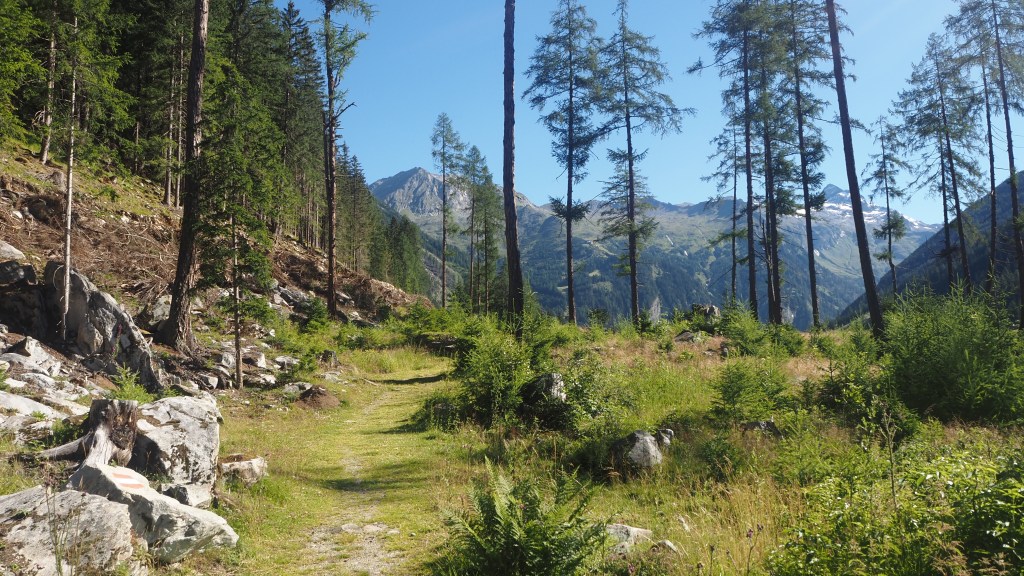
Hiking the Alpe Adria Trail: Day 7

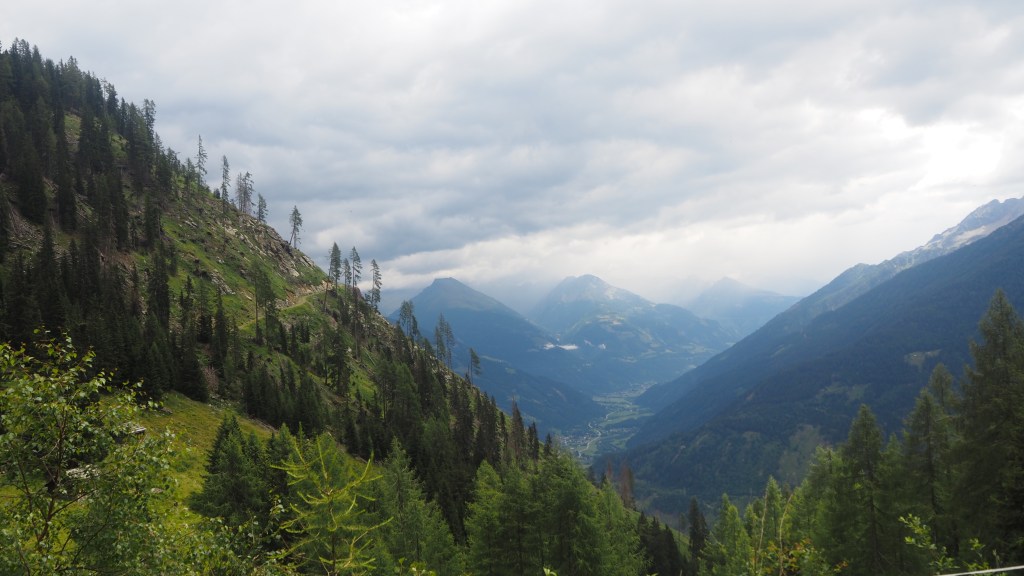
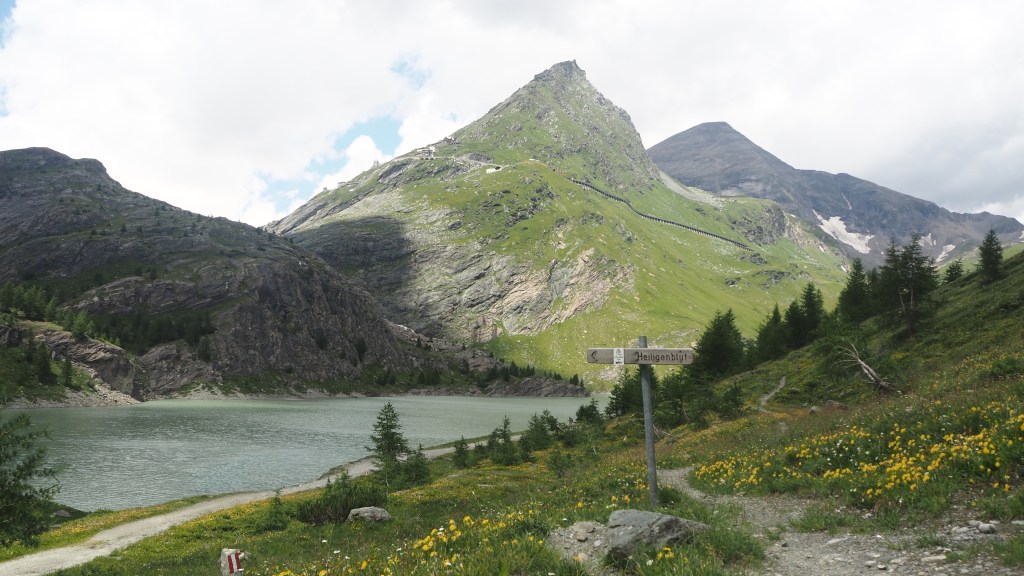
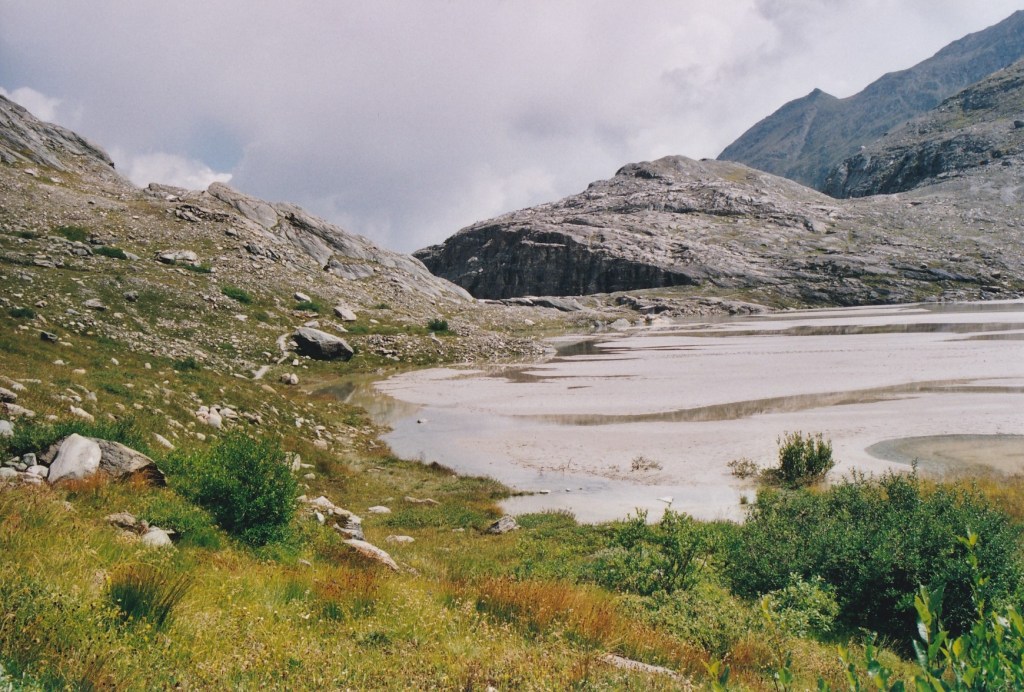
The walk north of Mallnitz towards Stappitzersee

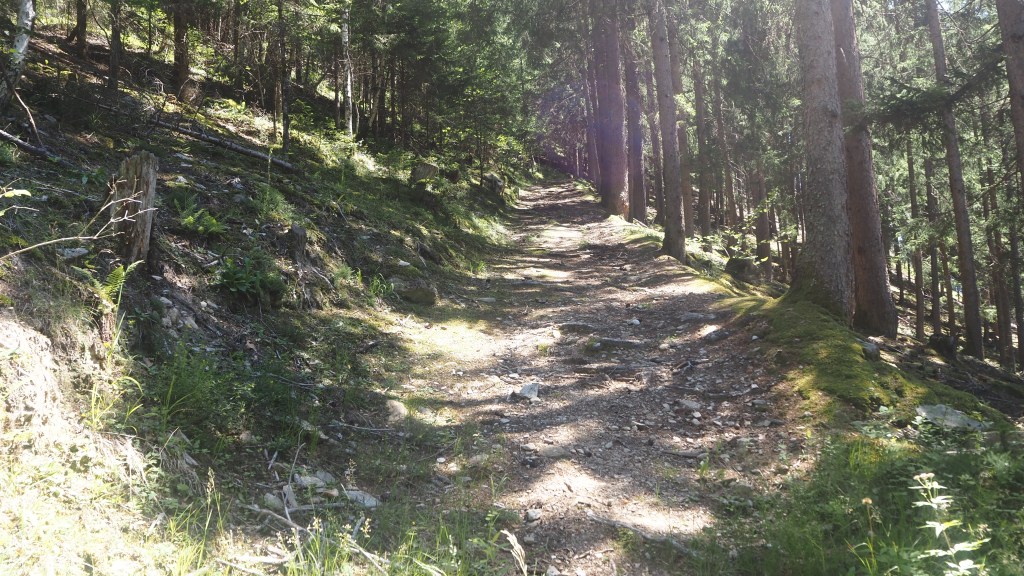
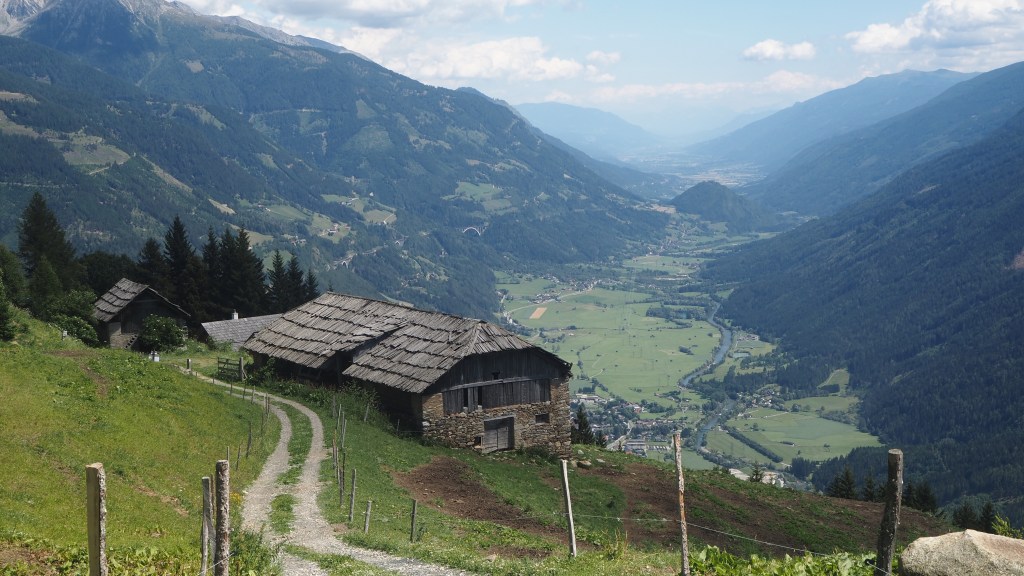
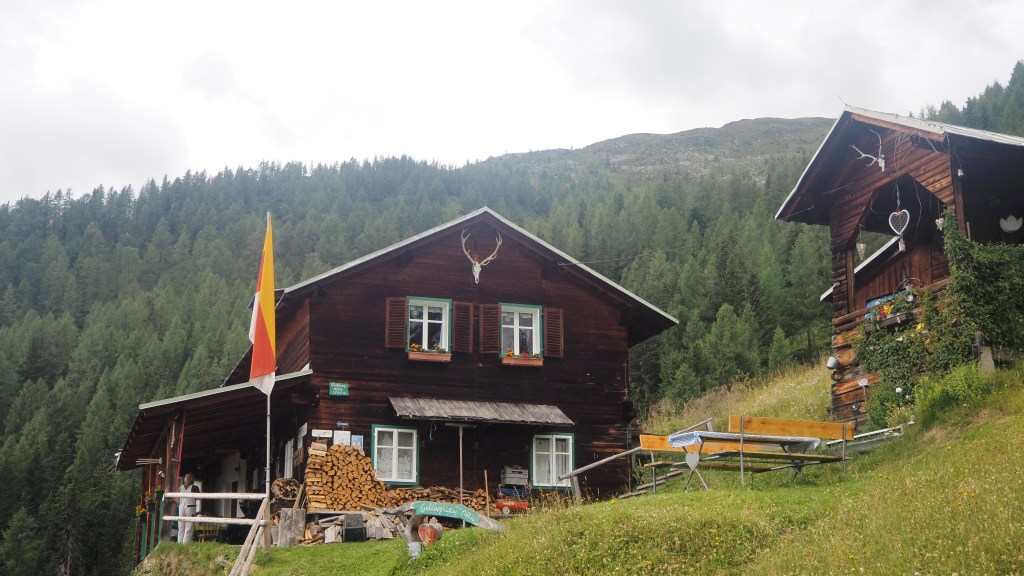
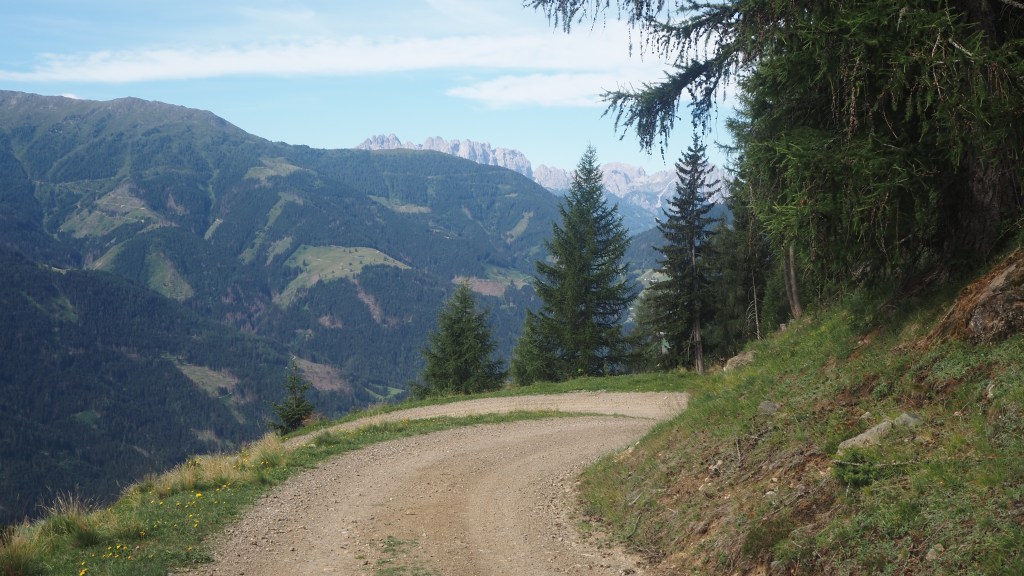
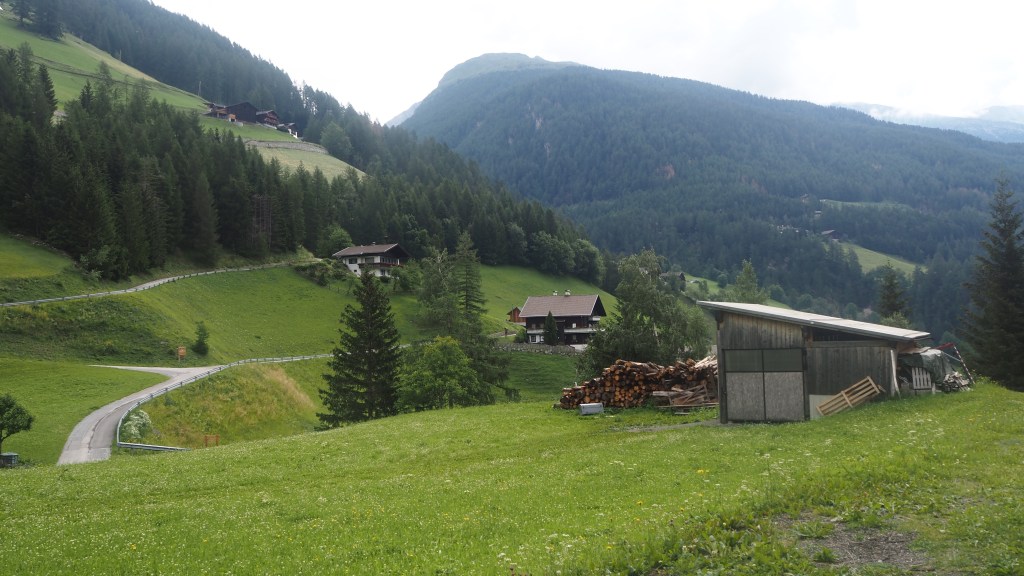
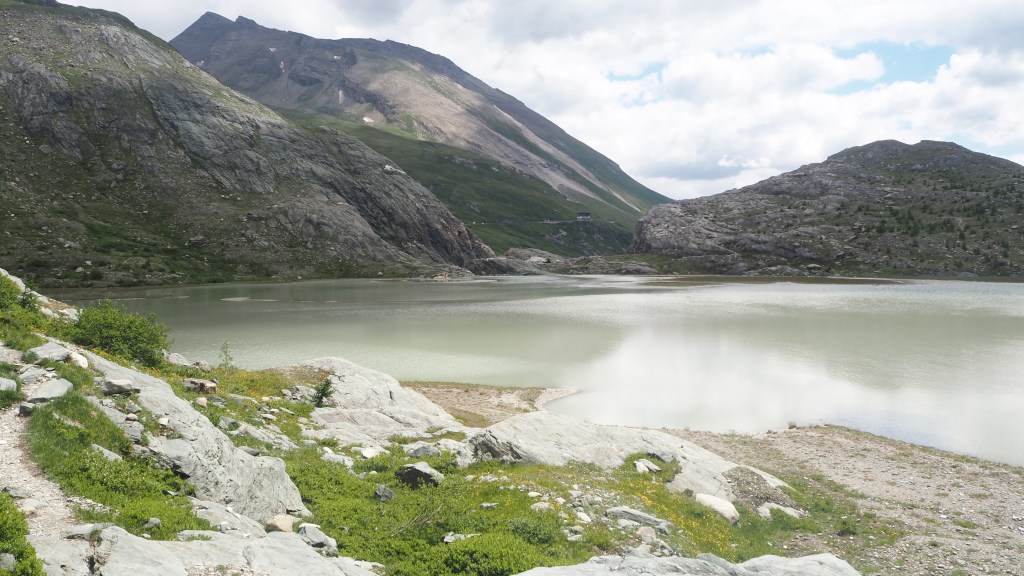
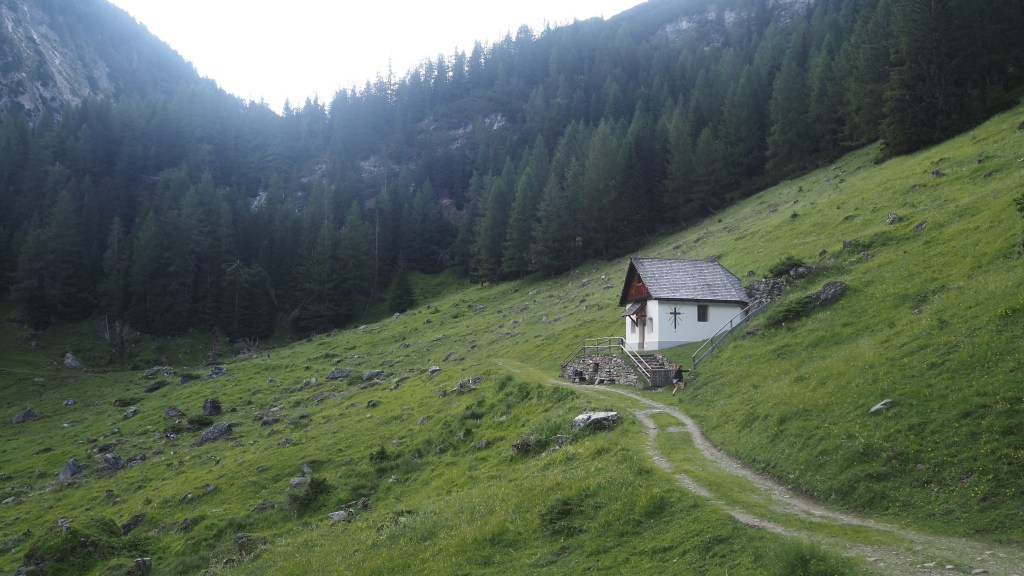
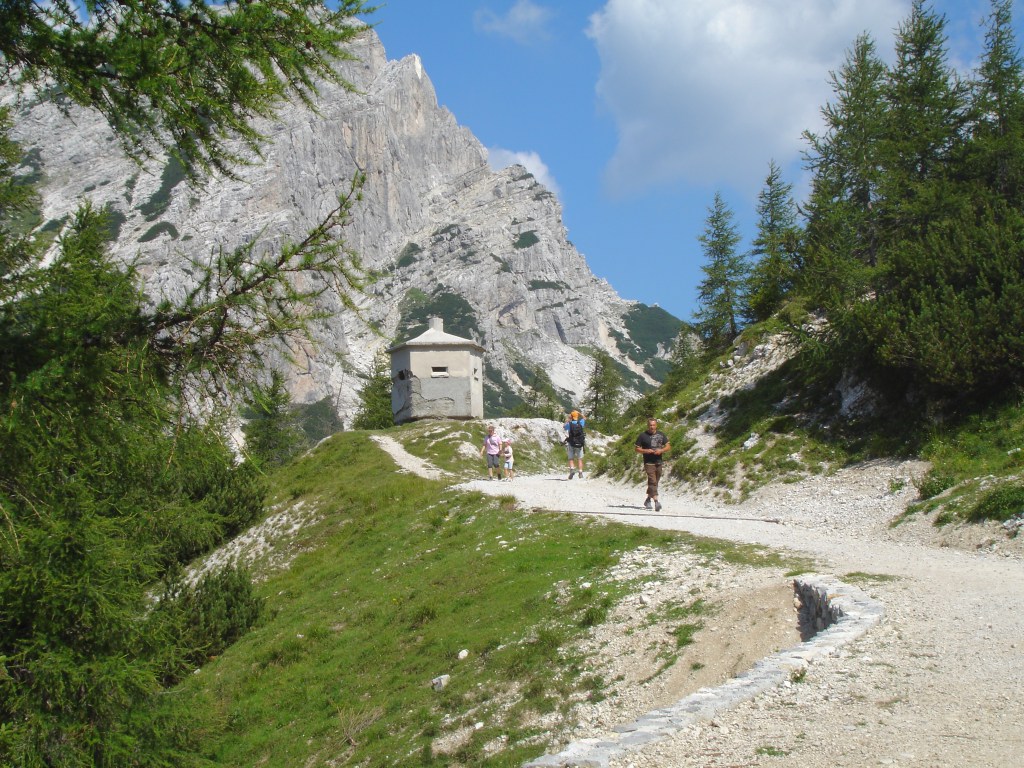
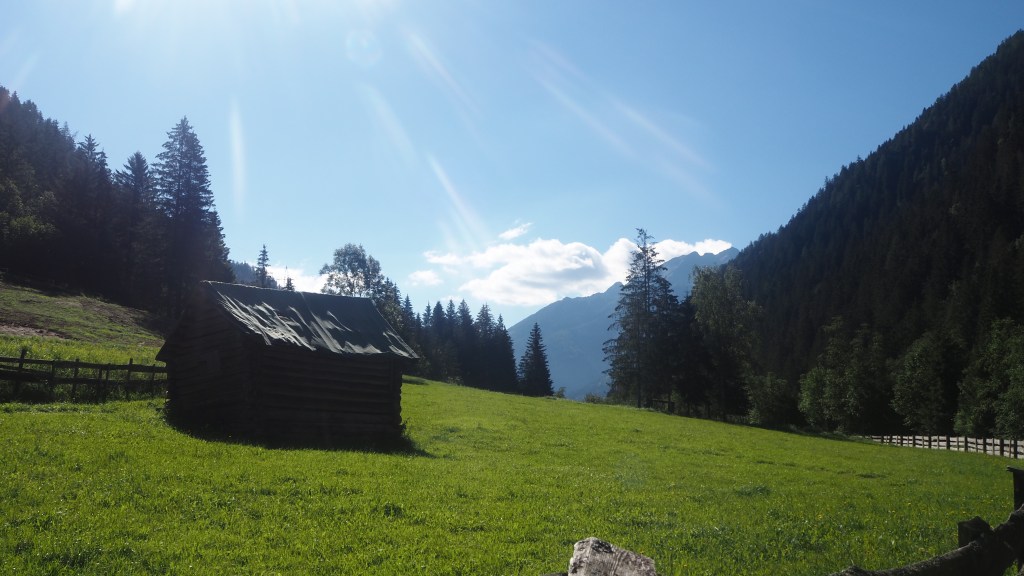
The walk today was, quite literally, gorgeous. By which I mean, not only beautiful, as you can see from the image above, but took in two magnificent gorges.

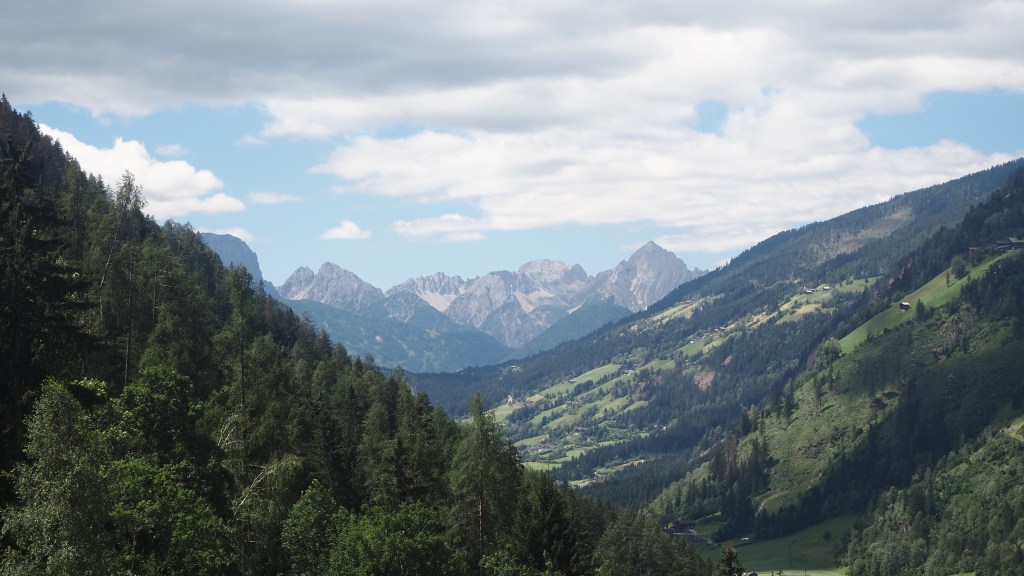
On the face of it, the route was a little unusual. First it headed north out of Mallnitz, on one side of the Winkelbach valley. The objective was ostensibly lake Stappitzersee, but to be honest it just gave an excuse to walk up the river valley one side and back down the other. Which was good enough for me, because it was an opportunity to enjoy an easy level walk with views to the head of the valley one way, and then see the view back south towards Mallnitz and Obervellach.
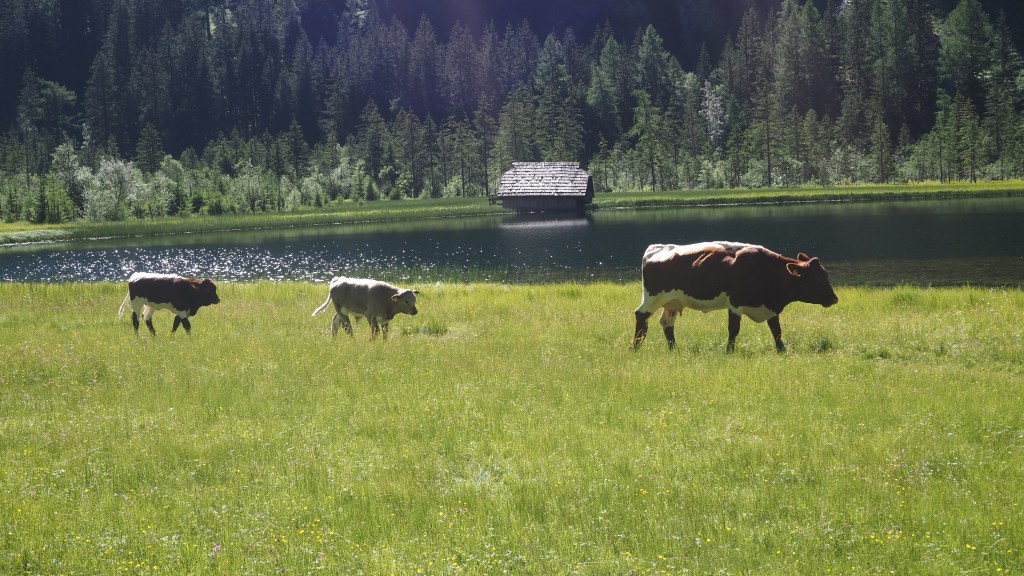
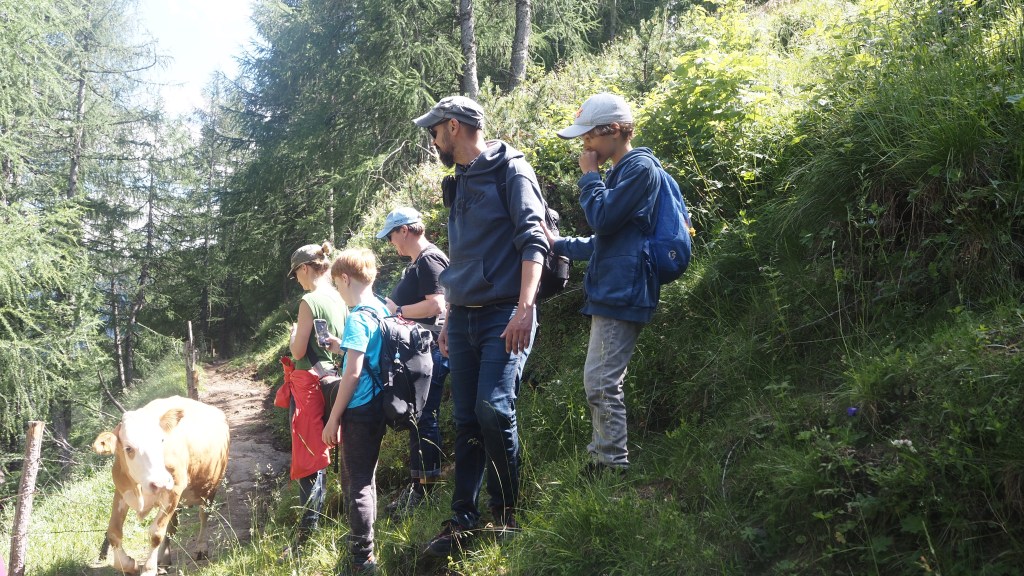
Cows and calves at Stappitzersee

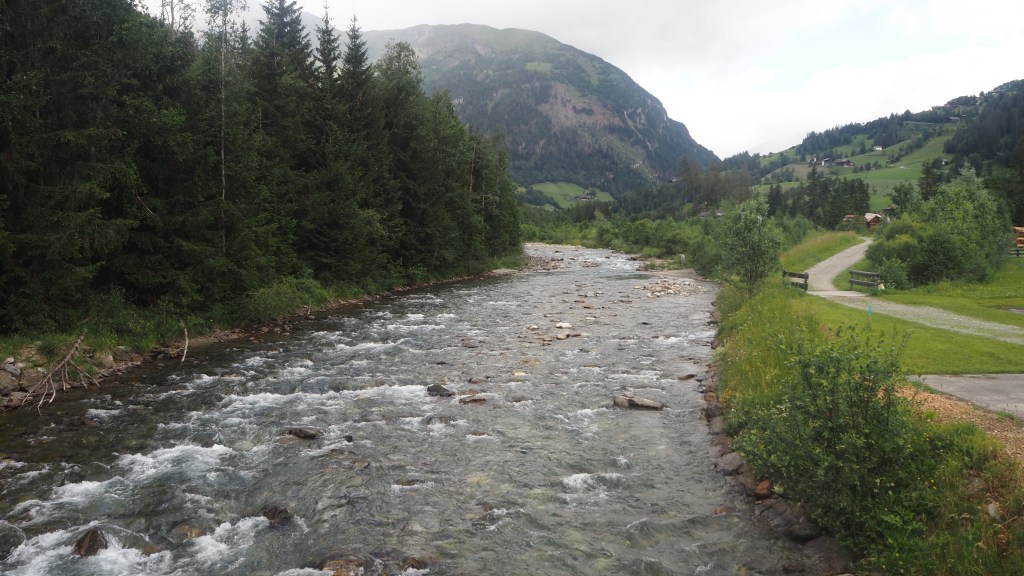
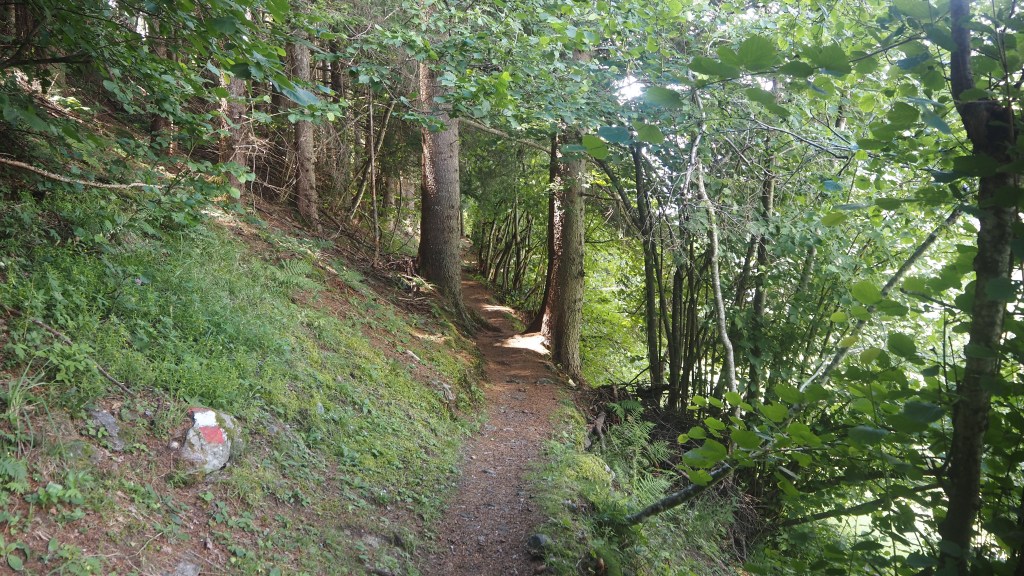
Most people clearly drove out of Mallnitz to a little car park near the lake, but to my mind that meant they missed the best bit, the lovely woodland and riverside walk between the town and the lake. Never mind, it meant once more I had most of this part of the walk to myself.

Coming back into Mallnitz, the valley became more industrialised, with the railway emerging from a tunnel under the Alps. A helicopter hovered overhead and I saw it carrying on a winch a cut-down pine, hanging it upside down, and then release the tree somewhere in the forest. I hoped they knew what they were doing, because it seemed a pretty dangerous activity to me, particularly with pylons and railway lines nearby. But maybe it was just easier to transport trees this way when on a steep hillside.

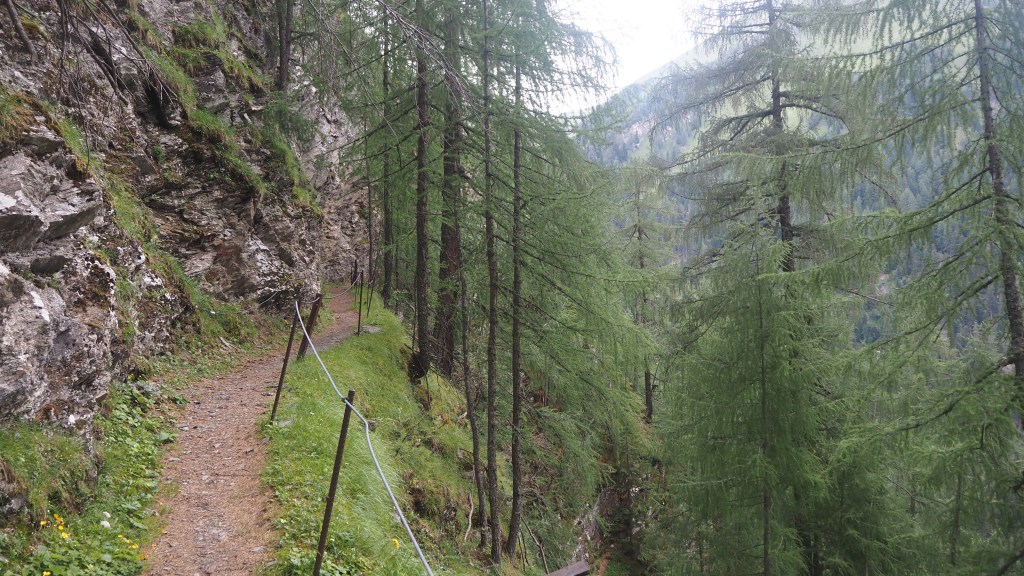
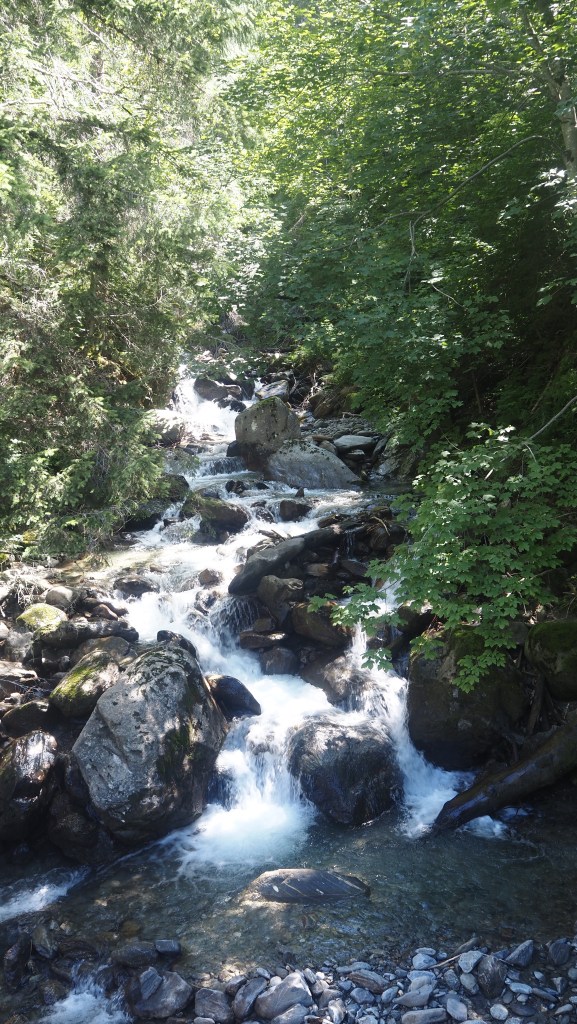
Not far past the railway station, itself a bit out of town, I began my walk alongside the first of today’s two gorges, Rabischschlut. Perhaps because this gorge lived in the shadow of the other one I visited later, and was a bit less dramatic, it seemed a bit neglected. No one was there when I arrived despite it being only a mile or so out of town. It could also be the walk was a little too hard for children and families. But having said this it wasn’t really difficult either- there were lots of tree roots, but there were also plenty of wooden steps . The noise and the power of the water was impressive and I found the usual handy seat to have lunch.
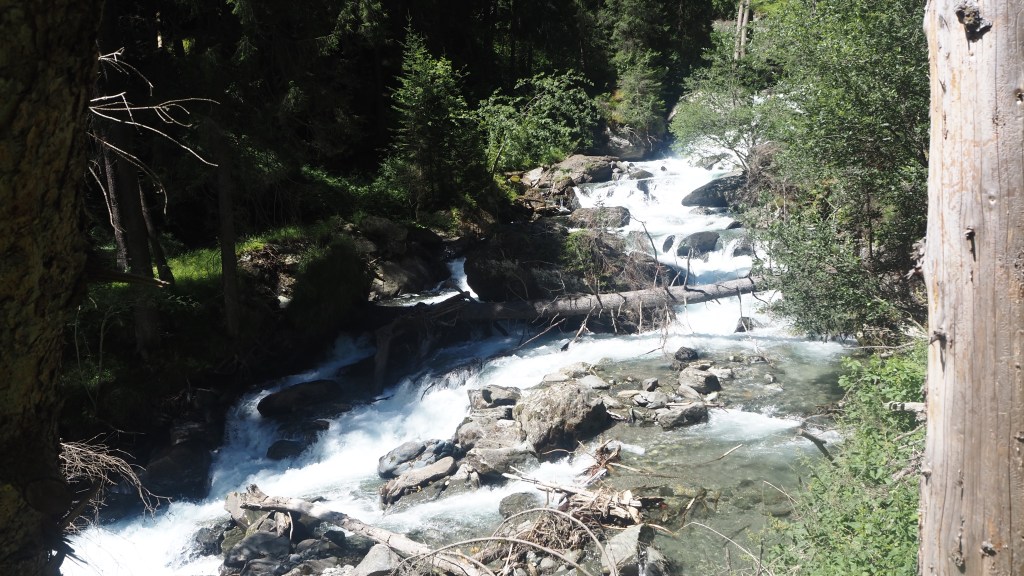
Rabischschlut gorge

After 45 minutes or so, I left the gorge and there was a little interlude of first farmland, and then woodland. When out of the shade, for the first time, it felt very hot – probably in the upper 20s (but not as hot as London today apparently). But even then there was often a cool breeze, and in the shade it remained very pleasant. I arrived back on the path I’d inadvertently joined on day six, before descending down to the next gorge, Groppensteinschlut.
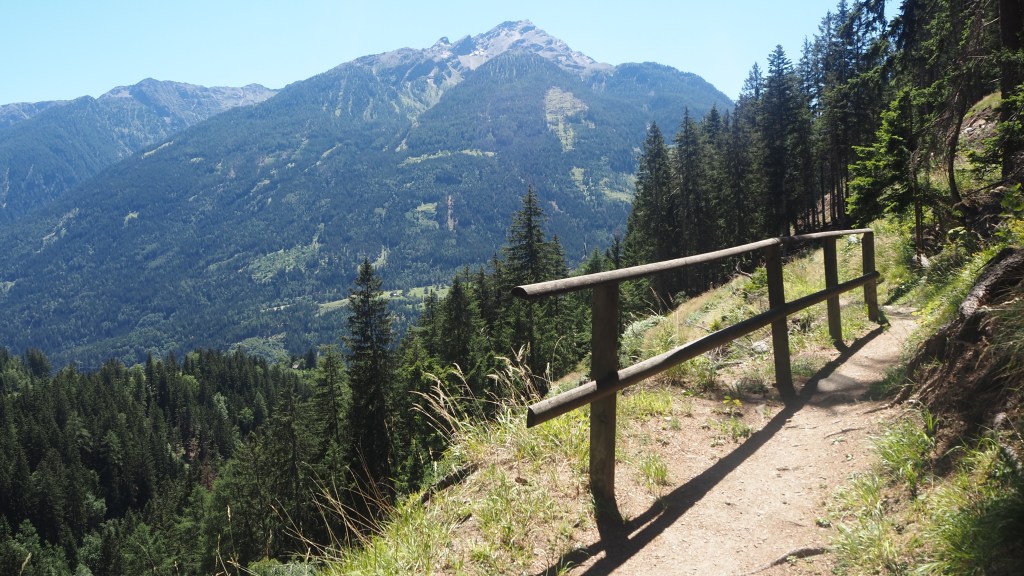
The route between the two gorges

Here I have a confession to make. I should have paid seven euros on my way out of Groppensteinschlut gorge, but I couldn’t see anywhere to do so. Only Alpe Adria Trail hikers were supposed to be walking north to south anyway, as everyone else parked at the southern end, and walked north, looping back by a different route. Luckily people didn’t seem to mind I was going the ‘wrong’ way, and it wasn’t particularly crowded.
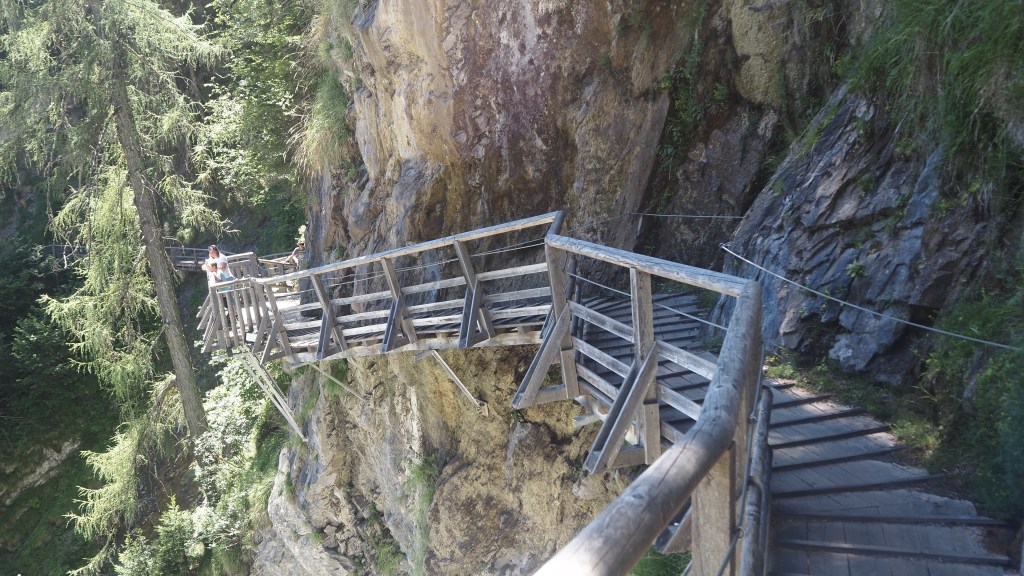
At Groppensteinschlut gorge, wooden walkways enabled an easy walk alongside dramatic waterfalls

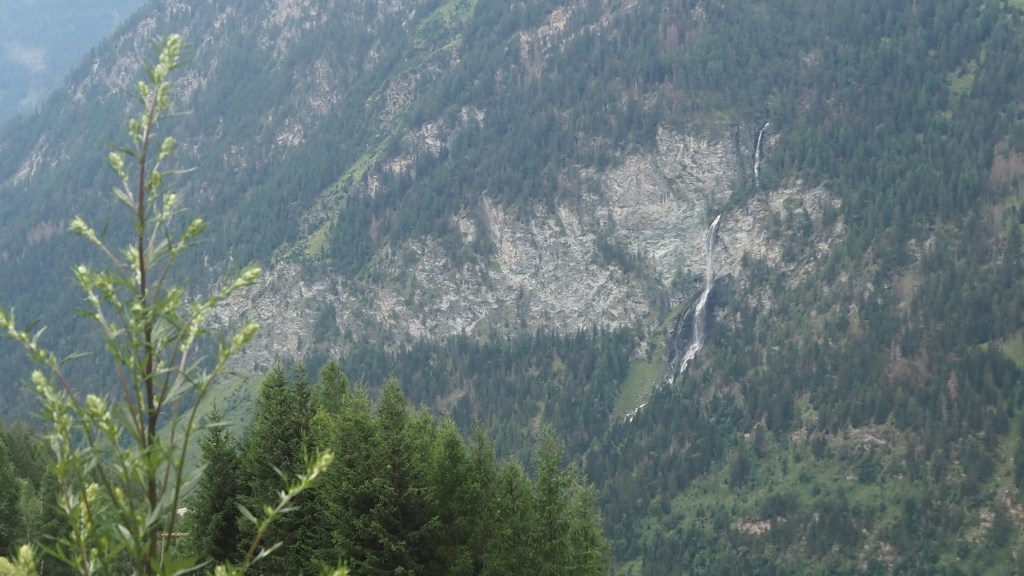
Entering the gorge what first struck you were the walkways, hanging from the sides of the gorge, looking like something out of an Escher painting. But as I descended past Zechnerfall and Groppenstein fall, and the rapids in between, it was impossible not to be drawn to, stop and admire the falls themselves, and the sheer power of the water. It was the same river, Mallnitzbach, as before, but the drops and force of the water seemed even greater than at Rabischschlut.
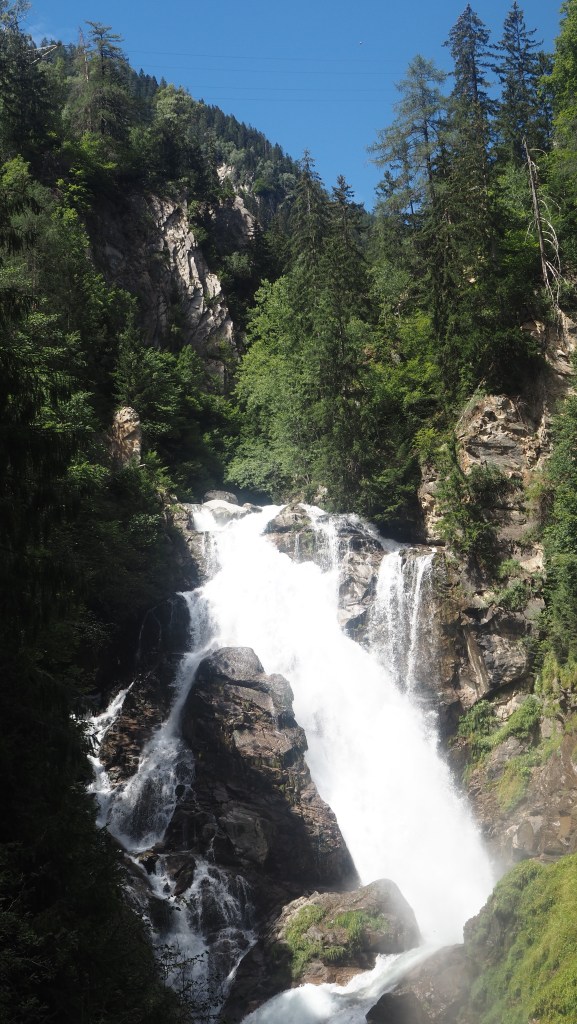
Groppenstein fall

At the bottom of Groppenstein, the light shining through the water produced this lovely rainbow, which isn’t done full justice in this photo, but which can at least give you an idea of how it looked.
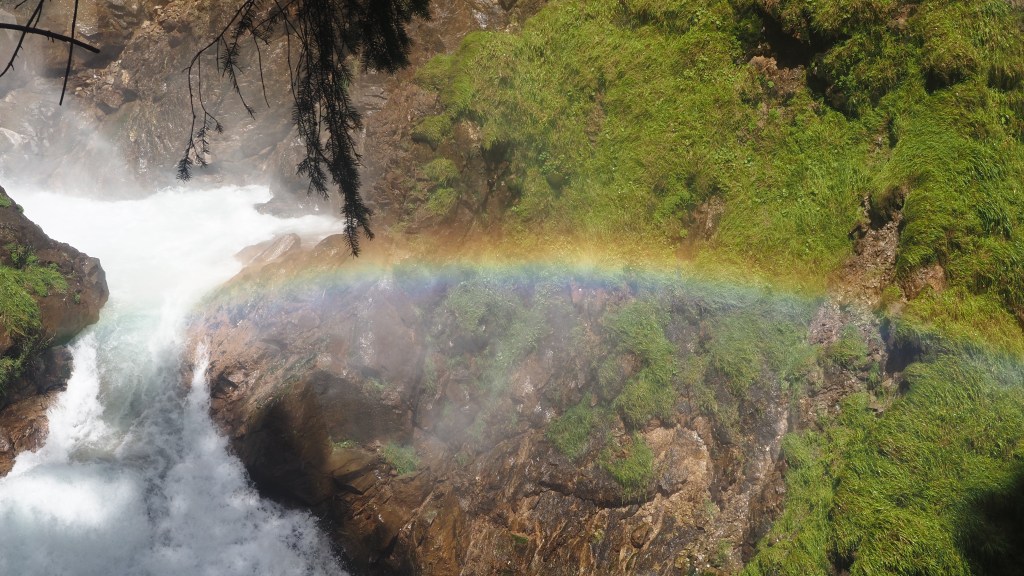
A prominent rainbow at the bottom of the fall

With the walkways being nice and shady, plus the spray from the water itself as you walked along them, this was a lovely end to the day. All that remained was a mile or so walk into Obervellach and my bed for the night.

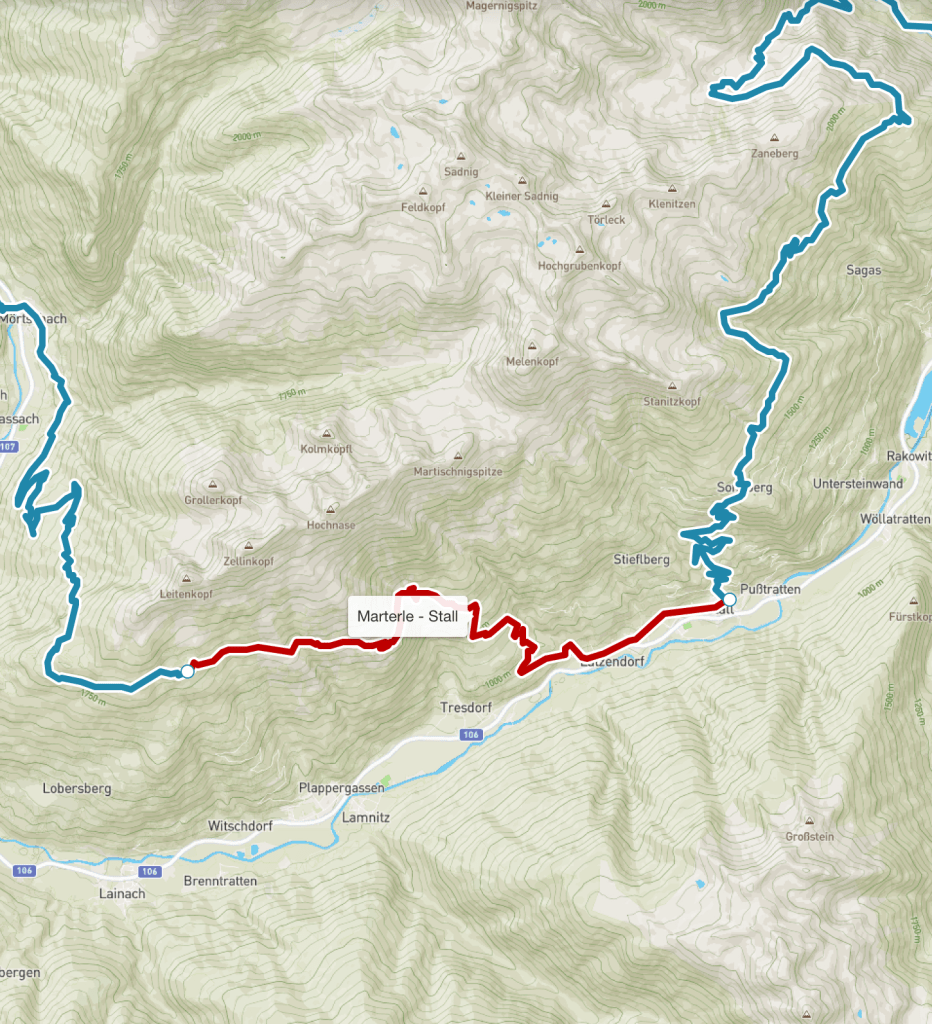
Today’s route led north up the valley from Mallnitz, then doubled back south to Obervellach. Total distance was 21.95 km, or 13.7 miles. Cumulative distance walked is now 141.7 km or 88.6 miles.

Tomorrow is also a shortish, easy day, although there is more uphill than today. I am only hoping that we don’t see the high 30s temperatures predicted in the UK here next week.
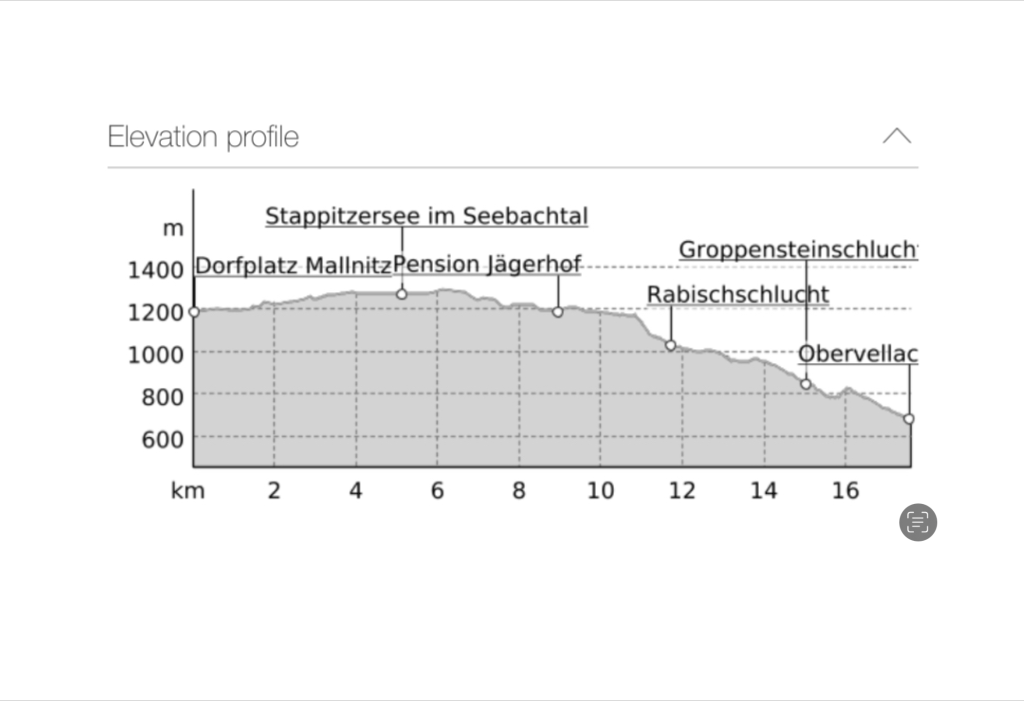
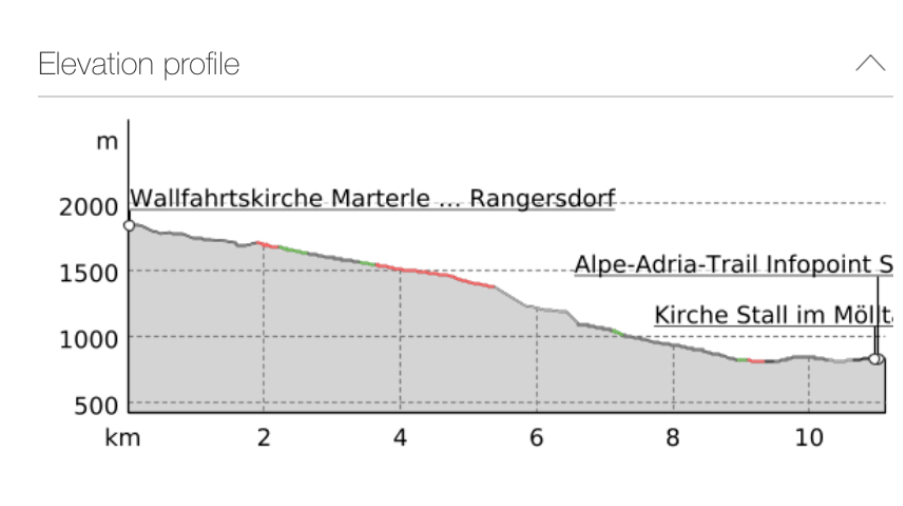
Ascent was negligible today: much of the walk was level, with a descent through the gorges. Gross ascent 325 metres, descent 806 metres. Cumulative gross ascent now 5028 metres.

Hiking the Alpe Adria Trail: Day 6

Early in the morning

Day six of my journey through the Alps to the Adriatic, for reasons that will become clearer, turned out to be probably even more long and arduous than day five. But when I set out in the morning, after taking a bus from my overnight hotel back to the route of the trail, although I knew that I had another big ascent and descent in prospect, I felt surprisingly refreshed after a good night’s sleep and was largely recovered from the efforts of the day before.

The first couple of hours I spent walking gently downhill and on the level, enjoying the pleasantly warm morning sunshine. I walked alongside the Fragantbach river for a while, through the village of Laas and down to the main road, which helpfully had a supermarket where I bought my picnic lunch.

Shortly after Flattach, the long climb up commenced. At first, in the full blaze of late morning sunshine, the sudden steepness quickly became a challenge. Soon the path led into shady forest, which made it less sweaty, but the path was unremittingly steep. I paused at a helpfully placed bench (in this region of Austria there seem to be a lot of these helpfully placed as rest points, picnic spots, or viewpoints).

The long climb up

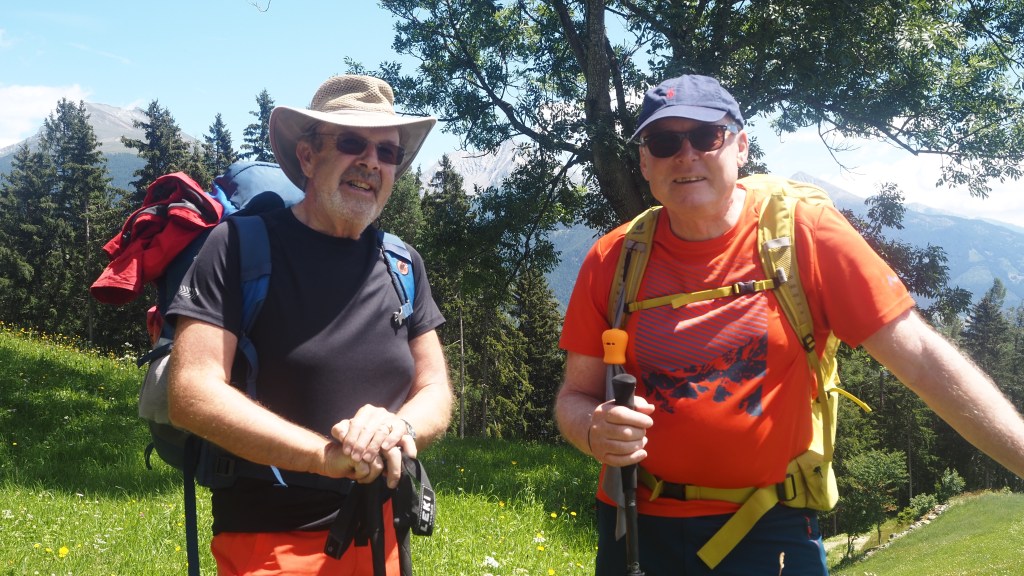
At the next bench I met two hikers, Karl and Haimo, who I had chatted to earlier that morning at the bus stop, and who, rather than walk the first part of today’s stage had opted to stay on the bus to Flattach and visit the nearby Raggaschlucht gorge instead. As they, like me, were walking the rest of this stage of the trail, we walked together for the next two or three hours, initially steeply up, soon then joining a quiet road which zigzagged its way to the highest point of today’s walk, near Staneralm, some 1500 metres above sea level.

Karl and Haimo, my walking companions for several hours today

Karl was a native of Austria, while Haimo was from Belgium, but it was Haimo, who had first visited the region some 45 years earlier, who was the more familiar with this region of the Alps. They were planning on hiking a week or so of the trail, having started the day after me, with the aim of returning later in the year to do some more. Once again, as with other conversations with people I’ve met on this trip, I felt a little embarrassed at how well they spoke English, when my German is non existent. We had an interesting and friendly chat- something I have encountered often when walking together with people you have never met before but who share a love of the mountains.

I think also they helped keep my pace up, but nevertheless it was still around 2pm before we gained the high point of the walk, and I had my lunch. At this point I said goodbye to Karl and Haimo, and having had a sit, started descending myself. One thing I do know is that not only can’t I walk when I’m hungry, but that I’m often very slow going down and I’m sure I would have held them up if we had continued together.

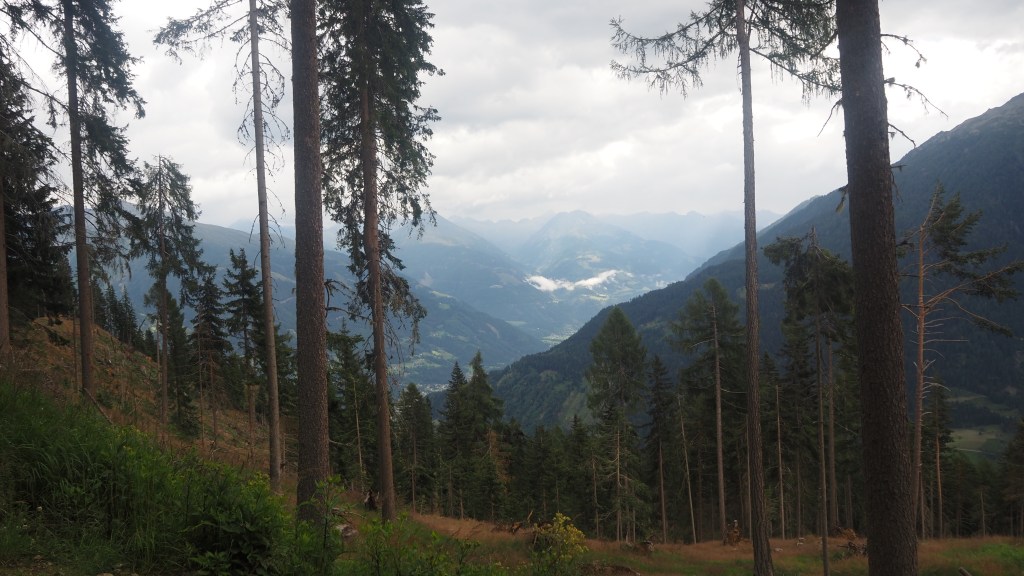
A new view, looking east, towards Danielsberg, (the ‘mound’ right of centre) where I’ll be heading next week

The views since reaching the top had unveiled a new panorama, this time eastwards towards Danielsberg- a seemingly diminutive hill against the backdrop of its neighbouring mountains, but which Karl and Haimo had said was a highlight of this region. The trail passes its summit and I should be there later in the week.
Starting the descent, looking towards Stanerhauser

After the huts of Stanerhauser, the path descended further to Himmelbauer, perched on a little crevice overlooking the valley, and home to a little restaurant with spectacular views from its terrace, which the trail passed through.

The path, winding its way across the hillside

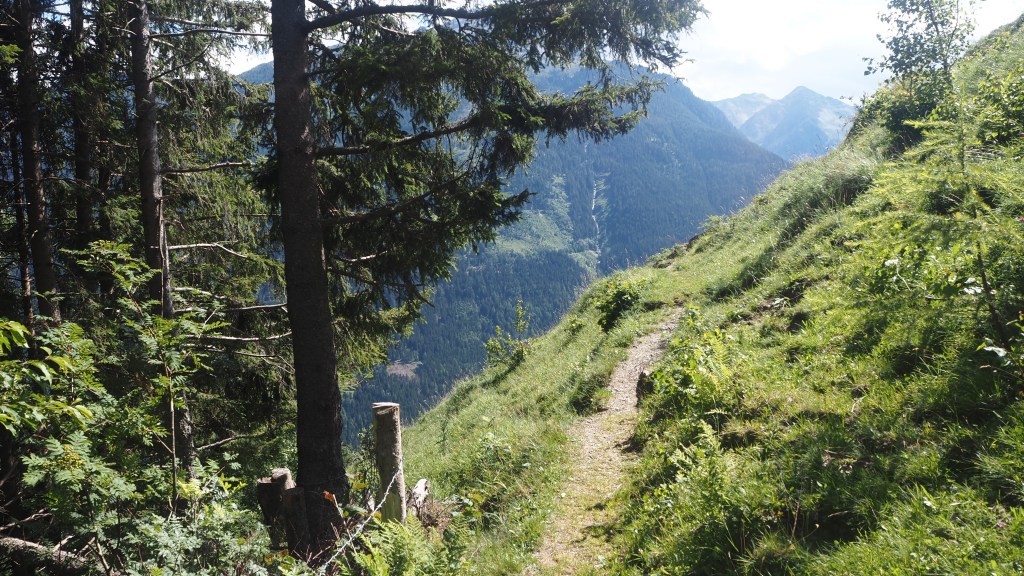
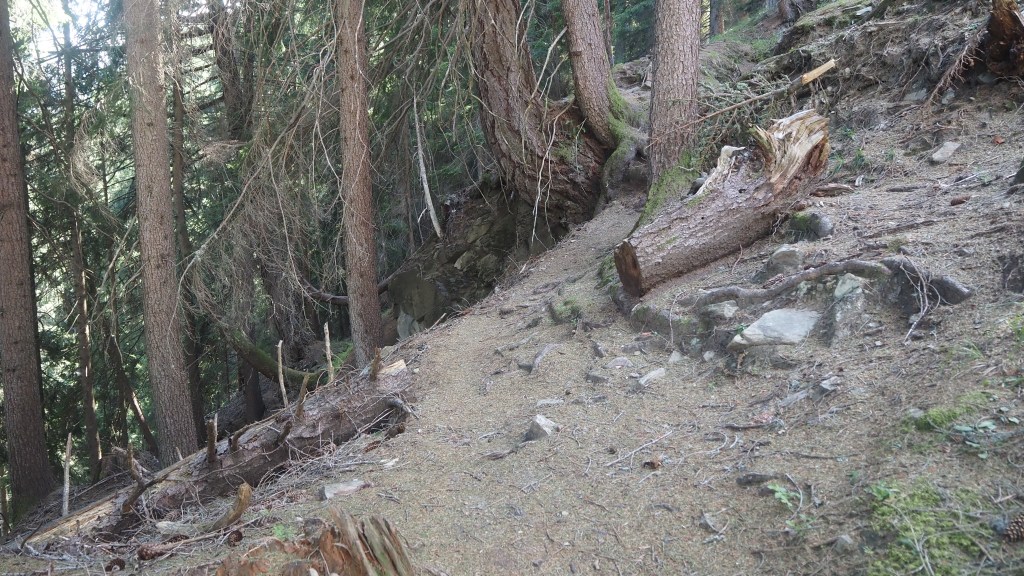
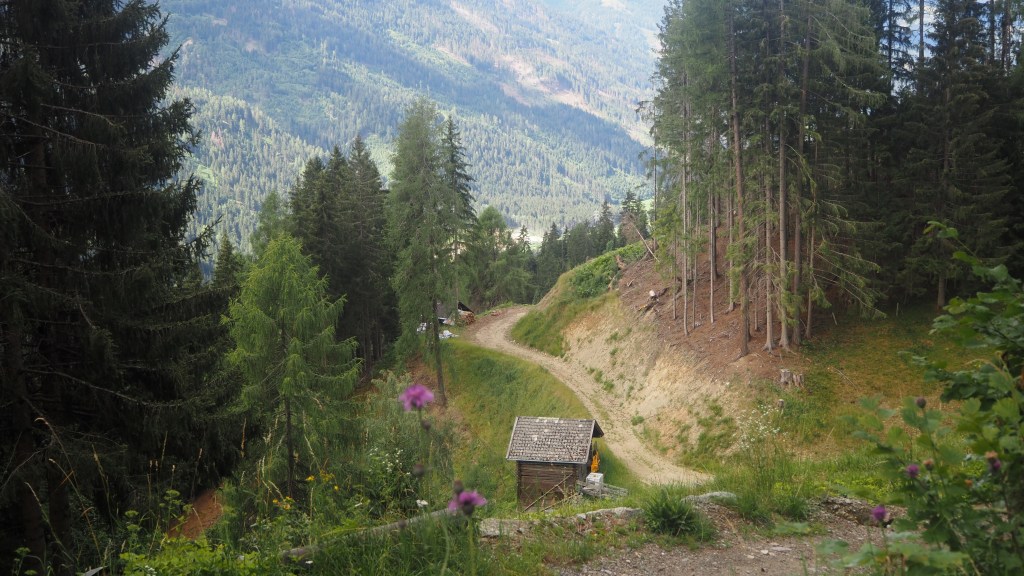
From here the path wound round the hillside and then back into the forest, where it again became narrow, uneven and tricky. It was not as bad as the area affected by tree and rockfalls yesterday before Goldberghutte, and luckily the ground was drier too today, but nonetheless this was the part of the day I enjoyed least and I was glad when after a while the path descended to a wide logging trail.

The route gets tricky again, as it enters the forest
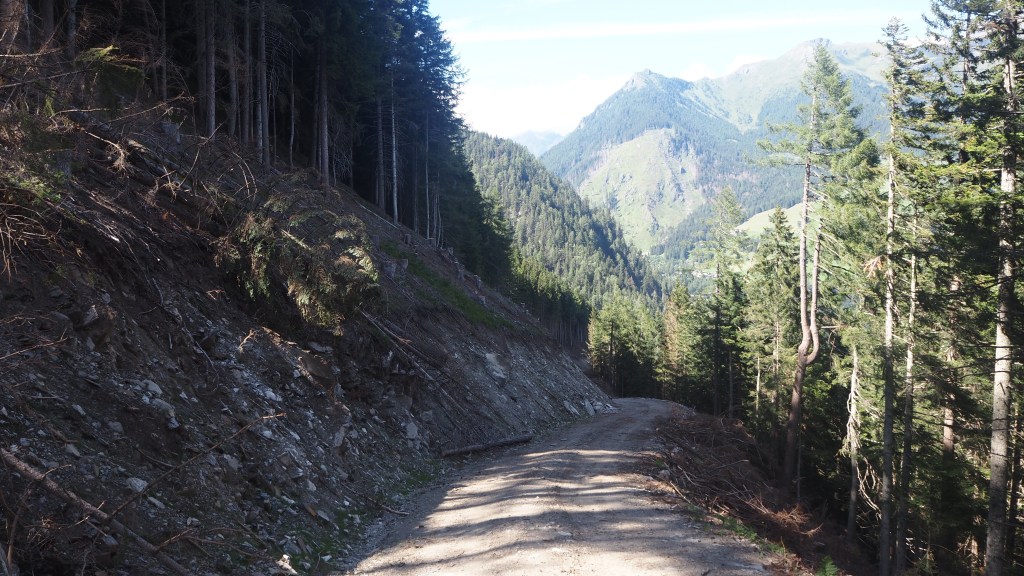
The forestry track that I decided to take, after wearying of watching every footstep in the forest

The official route from here was signed continuing downwards on a continuation of the narrow path but broadly parallel to the logging track. After I had begun walking on this path and had realised it was likely to be more of the same, I instead retraced my steps and took a gamble on following the logging track down instead. This was easy walking, being used by big vehicles, but it had to be said, not especially attractive to walk down, although the views beyond to the mountains remained magnificent.

However, when the logging track began zigzagging downhill far south of where my gps was showing as the official route, I realised that although the walk down this way would undoubtably be easier, and likely faster, I was going on a long detour to add to what was already going to be a long day. Finally after about 45 minutes on this seemingly never ending descent (going I knew not where) I could see on my gps we were approaching a path going in the right direction, and was relieved to see a sign off the track marked as the Alpe Adria trail. This puzzled me, but after checking on my app, I figured out that this must be part of the next day’s route from Mallnitz, my destination, not today’s towards it (the route doubles back around Mallnitz).

This section of path was a very pleasant level forest walk. But I wanted to cut back to the actual part of the trail I needed to be on today and this, unfortunately, meant coming off this path and following a sign to Mallnitz with yet more uphill, having descended further than I should have earlier.

Then to add to the confusion, on reaching the point I was aiming for it turned out that Alpe Adria trail had been rerouted compared to the track on my gps, so I had to follow the signs and phone app instead which led to yet more uphill and a further extra walk.

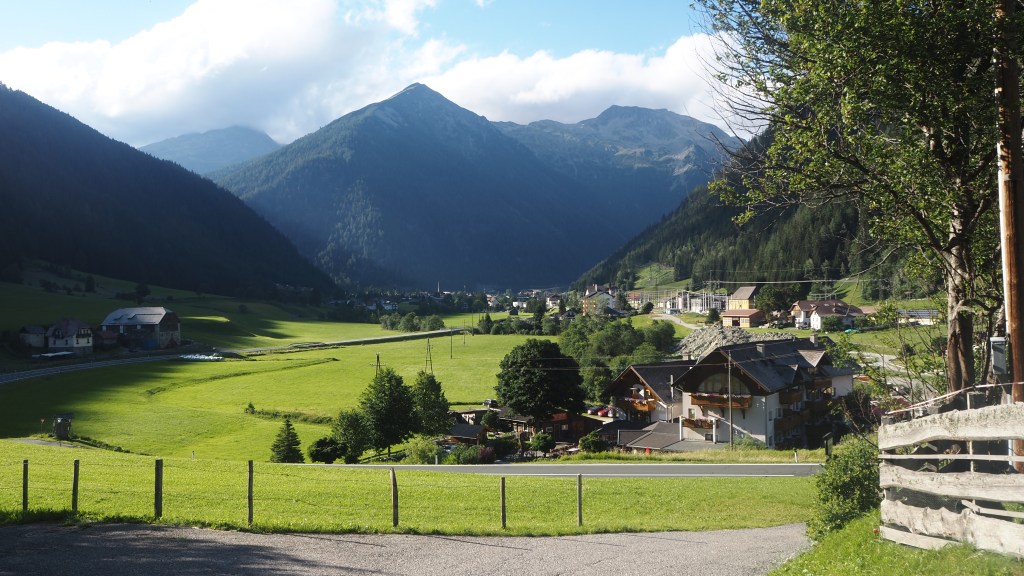
Mallnitz finally approaches.Destination at last, after 29 km (18 miles), 10 hours, and 1300 metres of ascent and descent

Finally I could see the end in sight- first the railway station at Mallnitz-Obervellach, where we had alighted from our train the previous week on our way to Heiligenblut, and then the town of Mallnitz itself ahead. It was still a further two km along farm tracks and between a river and the railway line before I finally arrived at my hotel in Mallnitz at about 7pm, having been walking for over nine hours. I had walked considerably further – some 29 km- and ascended and descended more than intended, when it would already have been a long day.

As a write this I am enjoying a welcome rest day then at Mallnitz, before a few easier stages of the walk in the coming week. Unfortunately, after my silly little slip on the grassy ramp outside Goldberghutte on day five, my back has been playing up, especially after I finished day six. Hopefully a day’s rest and recuperation, plus some medication will help.
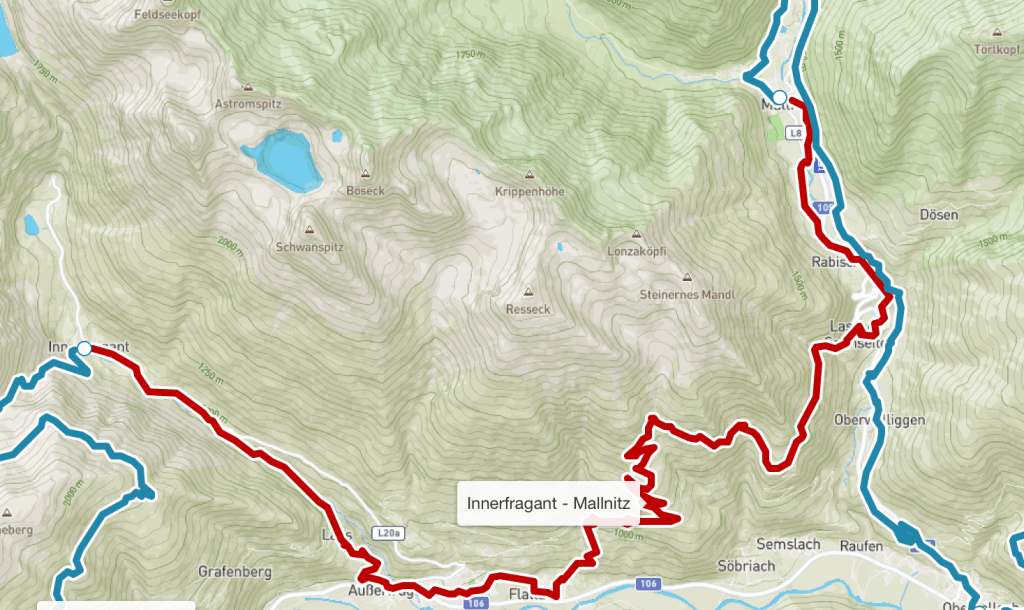
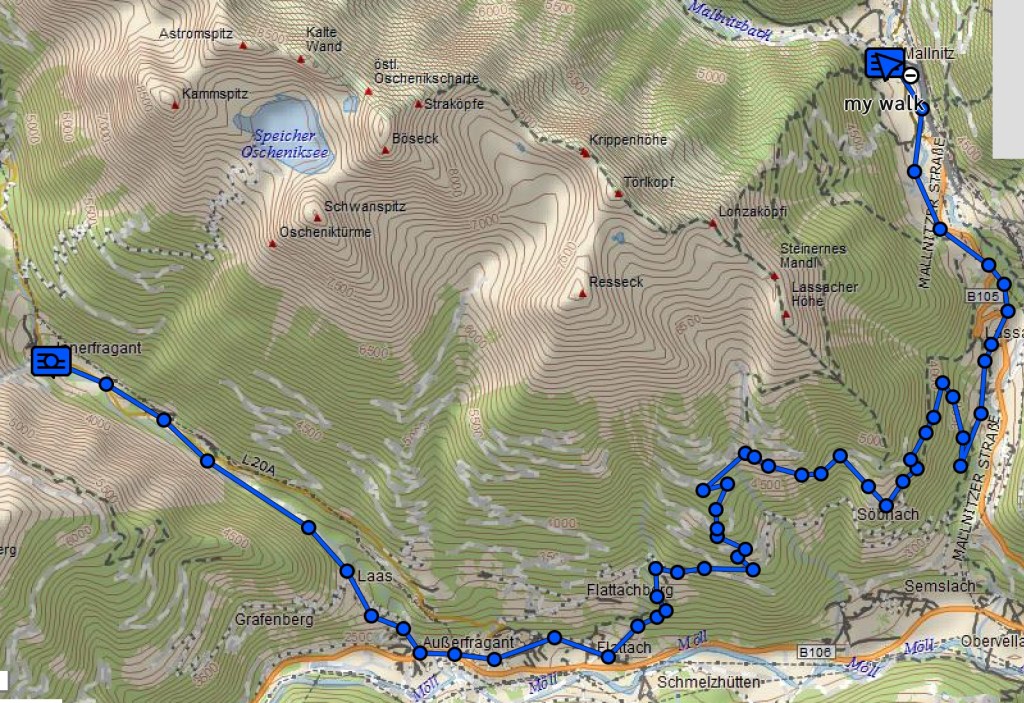
The intended route
My actual route, as tracked on my Garmin in-reach. The circles are tracking points, so the faster I walk the further apart they are. The detour I took is evident in the zig zag on the bottom right. My actual distance walked was 29 km, or 18.1 miles. Cumulative distance walked now 119.8 km (75 miles)
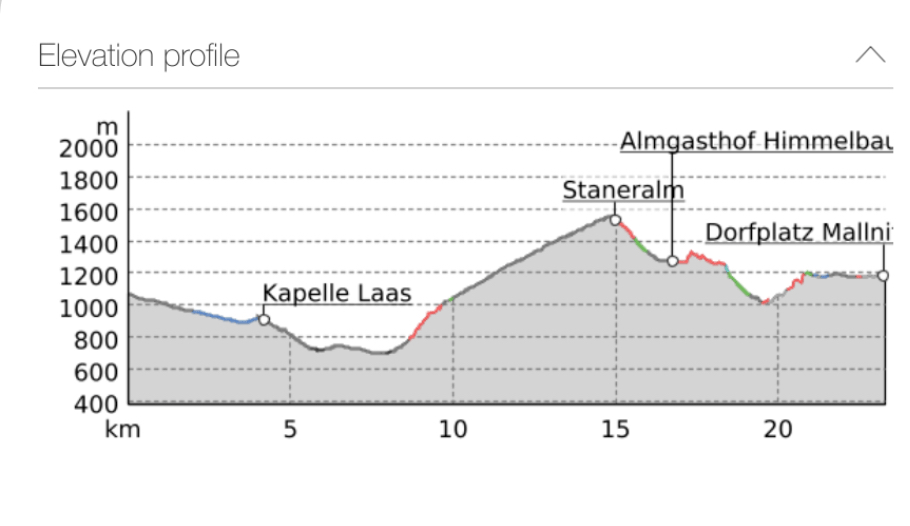
The intended route profile. I went lower than I should have done after a Himmelbauer and hence had to climb more at the end too. My actual gross ascent today was 1332 metres, and total cumulative ascent is now 4703 metres.

Hiking the Alpe Adria Trail: Day 5

A typical view from today, of a Heidi like cabin on the hillside, beside forest.

How can I describe today? The word that comes to mind is ‘epic’. At different points in the day I thought this was the most wonderful walk, the most awful, the most beautiful, the most tiring. It’s certainly one of the toughest I’ve ever done, perhaps even the toughest. Why?

Mountain views through the forest

Well it began with an inexorable climb, along switch back roads, with the odd, even steeper, path shortcutting across the fields. The weather was a bit changeable all day, starting wet, and it turned out the only really sunny bit of the day coincided with the steep, exhausting climb while for the rest of the day it was damp, grey and increasingly chilly.

Another magnificent vista

But the views were once again spectacular, and different again from before. By about 12 o’clock, I had done most of the climbing, and not having been able to buy lunch from the supermarket at Stall where I started, it being Sunday and the shops shut, I stopped for a snack.

While I sat snacking , a lady hiker- only the second person I’d seen that day- stopped briefly to chat. She told me her name was Barbara and not only was she hiking the Alpe Adria in full like me, but she had only started the day before and had done the first three days in one. Today she was doing both stages four and five. Knowing now what they involve I think she must be superhuman! Anyway it wasn’t long before she was haring off into the distance. I’m sure she finished her ‘double’ day well before I finished my single one.

The path started getting more tricky soon after I had stopped for a snack

Shortly after we chatted the wide path became a narrow and increasingly steep one, and there then followed the first of two stretches where the path had obviously been the victim of falling trees, boulders or avalanches. As a result there was barely a flat space to put a foot at times, the ‘path’ was only discernible because someone had thoughtfully splashed white paint on every few trees, and I slowed down to a snails’ pace. You had to climb over fallen trees, climb up and around bigger ones and walk through sloping narrow paths above a steep drop to the right. Because I took this so carefully, these parts took me probably nearly an hour to go less than half a mile. At one point another hiker also overtook me and seemed to take it all in her stride.

…and then got worse and worse…

I knew that a mountain hut for which I was aiming was nearby, because I had seen it, and could hear the bells of the cattle close, outside the forest. When I finally emerged from this nightmare, I followed a path under a field of cows, and was making my way towards a fence but couldn’t see a way out. Suddenly, a young woman in the hut ahead started waving and calling to me in German. When I explained I was English and didn’t speak German, she came out of the hut and showed me the way across. I’d hoped I’d finally arrived at Goldberghutte, and so it now proved. She welcomed me in, sat me in the piping hot kitchen, and offered me hot soup and to dry my waterproofs. So for the next hour or so, I was made to feel at home by Jussi and Manuela ( I hope I have their names right) in the homely Goldberghutte.

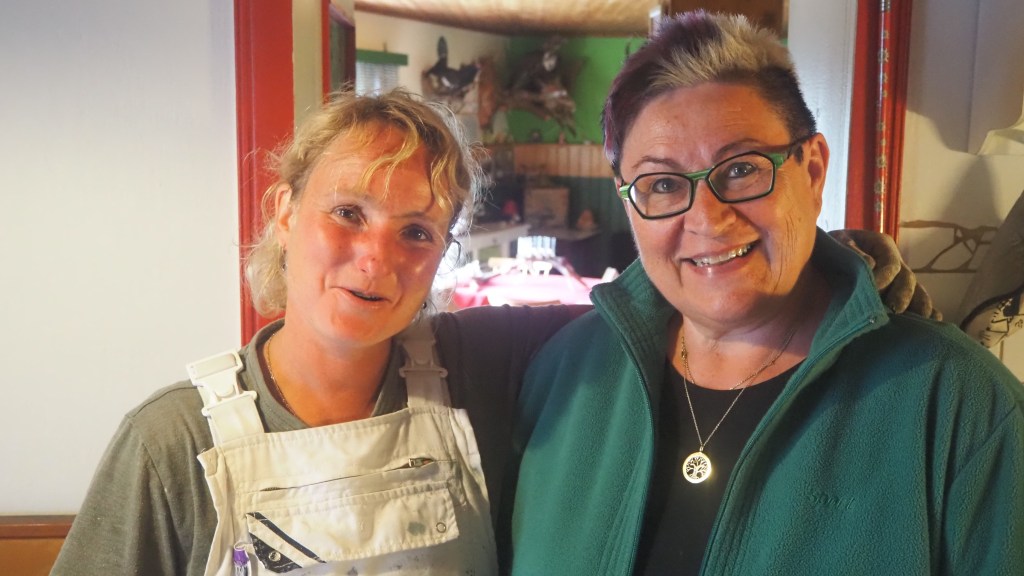
Jussi and Manuela, from Goldberghutte. They both made me feel very welcome
The Goldberghutte

Having said our farewells, I promptly slipped on a wet grass slope leading back down to the path. Ironic after all the care I’d taken earlier, but I’m glad it was there and not where it was more dangerous, as I just picked myself up and carried on. But it showed how lethal wet sloping grass can be.

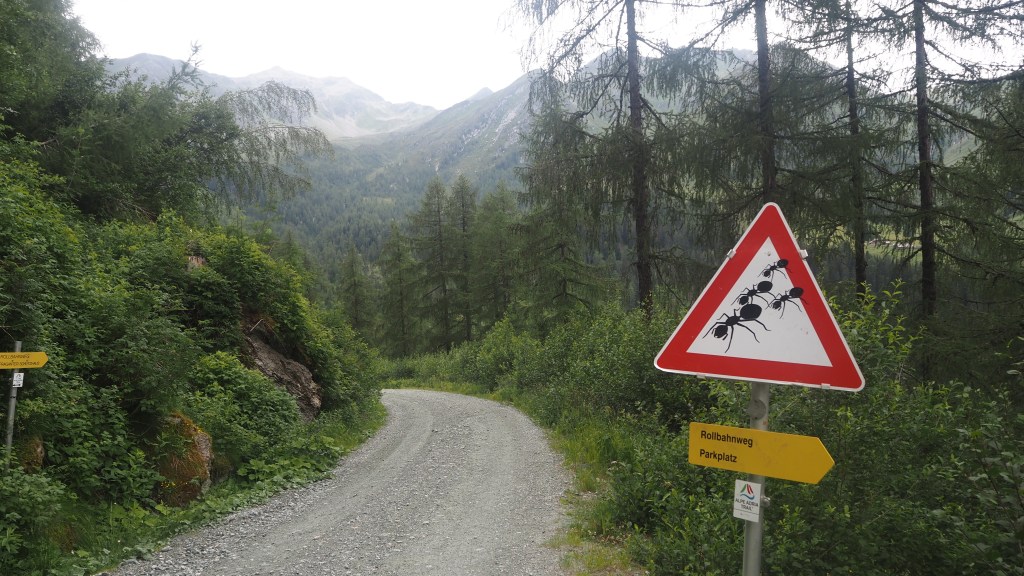
Most of the rest of the walk was downhill or level. For nearly an hour I walked along the Rollbahn weg, a level track of an old narrow industrial rail line. With a car park at one end and being a Sunday, I actually saw two groups of six or seven people out for an afternoon stroll, more people than I’d seen for days on the trail.

The Rollbahn weg
A sign I’d never seen before, warning of ants!

But the trouble was I knew there was all that height still to lose, and once it started in earnest, for the last couple of miles into Innerfragant, where this stage of the walk ended, it was seriously steep and long. And made up of that rubble, ballast-like, loose stone which is hard on your feet at the end of the day and means you have to watch every step to avoid sliding downhill.

Finally, arriving in the village, I should have taken up the offer to call my hotel to pick me up, as the hotel was another mile away from the trail up the road. But my guidebook said it was only 25 minutes walk, and I thought: what’s that after nine hours on my feet? Besides I would have had to rake around to find the phone number and hope that they spoke English. So rashly, I walked it, not realising until too late it was all uphill. Weirdly, the 2 million Euro EU funded road saw only one, yes one car, in one direction for the whole mile I walked it. By the time I reached the hotel, which turned out to be a touch of luxury compared to recent nights, I was exhausted.

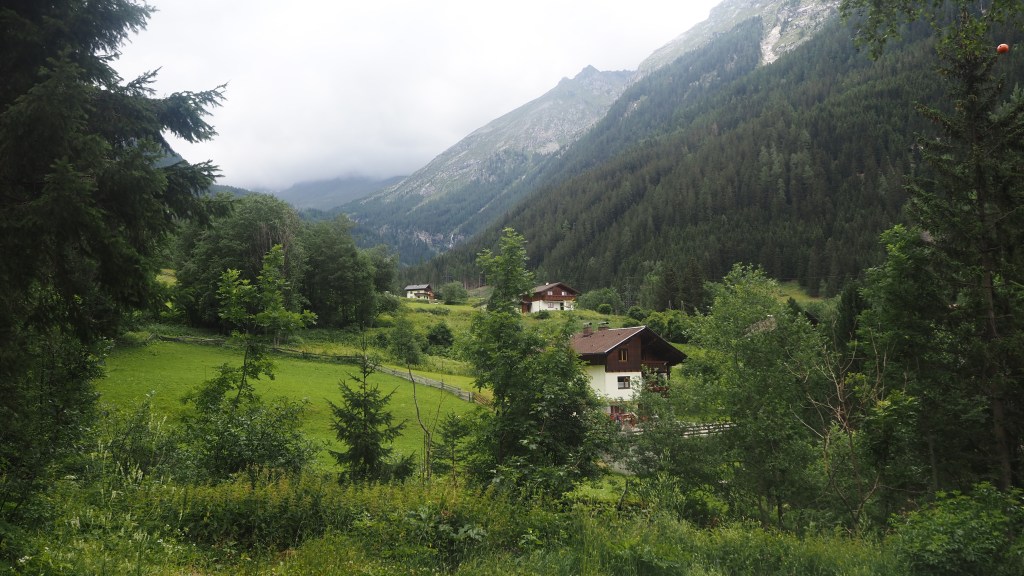
The welcome sight of Innerfragant, at the end of a long descent

So there we are. The first of the five ‘difficult’ days on the trail. A climb the height of Ben Nevis, and a descent almost as much, and I did it. Tomorrow’s walk is classed as moderate, but ominously seems to have almost as much up and down, and be as long distance-wise as today. Maybe it’s just easier going. I hope so. Today’s hike was very enjoyable in parts, but a nightmare at times. But, hopefully, it shouldn’t get much tougher than this.

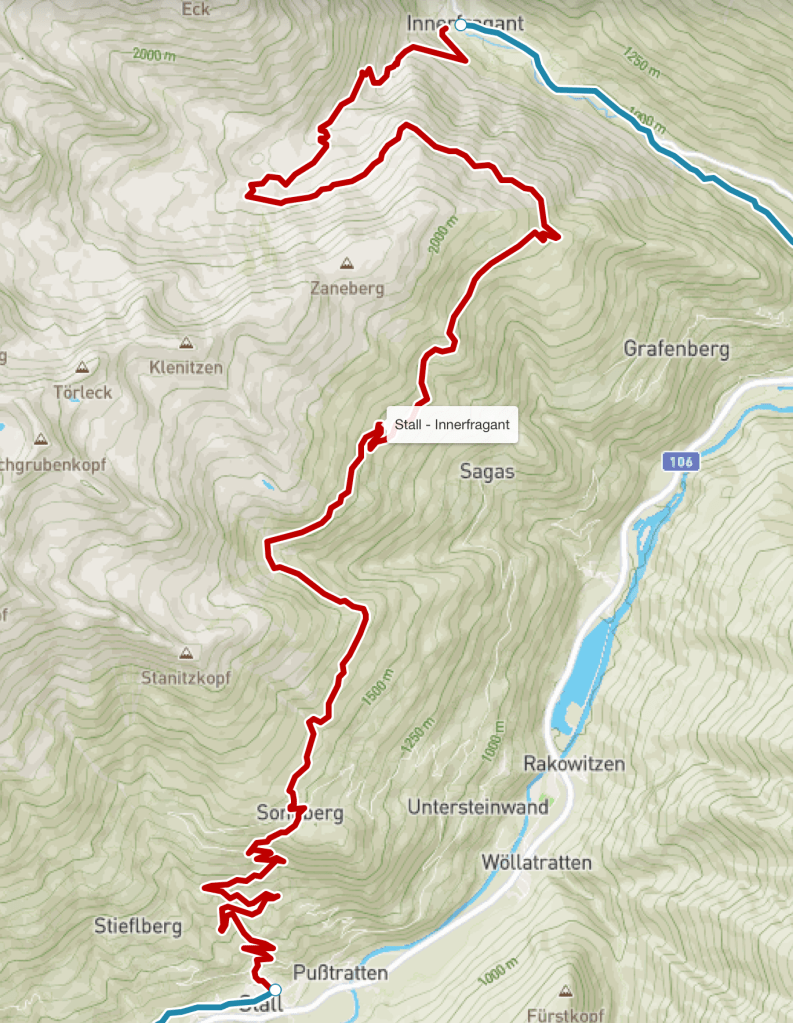
Today’s hike, include the extra walk to the hotel, came to 25.9 km or 16.1 miles. I have now walked 90.81 km (56.8 miles) over five days
The hike today climbed up, had a level section and descended sharply. Total gross ascent was 1365 metres, descent 997 metres. I have now climbed 3371 metres over five days.

Hiking the Alpe Adria Trail: Day 4

To be honest I was surprised I slept as well as I did in the cabin, but come 6 am every little movement of my neighbours, including going to the loo and the dog next door meant I gave up on sleep and thought I’d try my luck in grabbing an early shower (a bit of an experience when you have to go outside, see if anyone is up to give you a key, and then go back again, then give the key back afterwards and finally back to your room). Anyway the net result was I started really early today, about 8 am which was good to avoid too much of the afternoon heat.

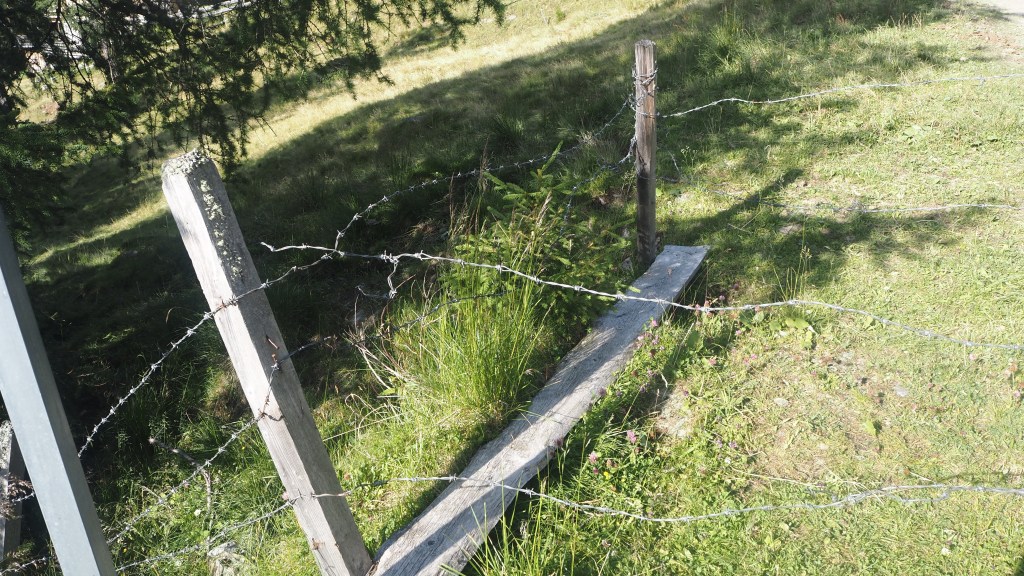
One of several barbed wire fences I had to cross on the first part of the walk

In contrast to yesterday’s walk today’s was almost all down hill. And for the first two thirds at least, it was relatively straightforward and really beautiful. More open than yesterday, and feeling more remote than the day before, the walk boasted wonderful views wherever you looked. There was the oddity of having to cross a number of barbed wire fences, warned about in the book, and clearly the right way to go by the accompanying signs. I had learnt from my Devon trip how easy it was to tear your trousers when crossing these so had to be extremely careful.

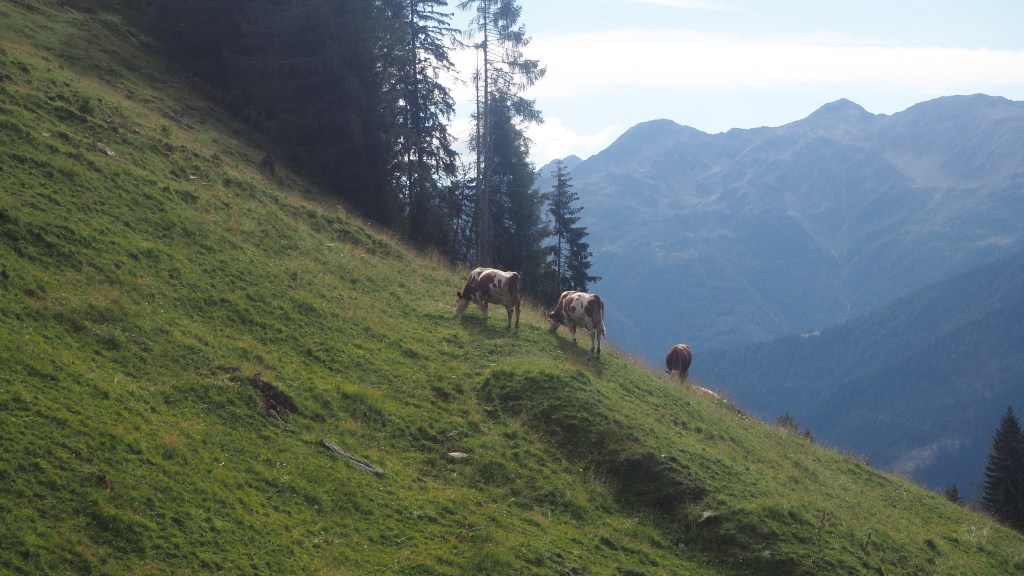
Cattle on the hillside.
Big open views featured throughout today’s walk

After a while the paths met a farm track and it was then easy going downhill on an open switchback route, with little bits where you could cut off corners by taking a path. This accounted for about half the descent so I was feeling confident today would have few challenges. However I should have known better…

One of the easier bits of forest path

After reaching a village and the taking a little descending forest path, an enormous gaping gulf in the side of the hill emerged, and the path started to lead very steeply down the near side of it, though forest. In one or two bits I shuffled on my back almost sliding down as it felt safer, with the ground being a bit loose. Luckily this part didn’t last too long, but I did find that when you did this, standing up again was really quite difficult, especially with a heavier than usual rucksack. Anyway, at this point an Austrian couple I’d seen at the mountain cabins passed me by and shortly after I joined a little lane with a suitably placed bench where I could have a snack, admire the views and take a breather.

From there on in, it was very straightforward and a bit more built up. At one point I heard what sounded like an air raid siren, and wondered whether things had been getting worse since I left home! It turned out as I descended that there was a massive timber plant in the valley, and the siren being exactly at midday was probably a factory whistle.

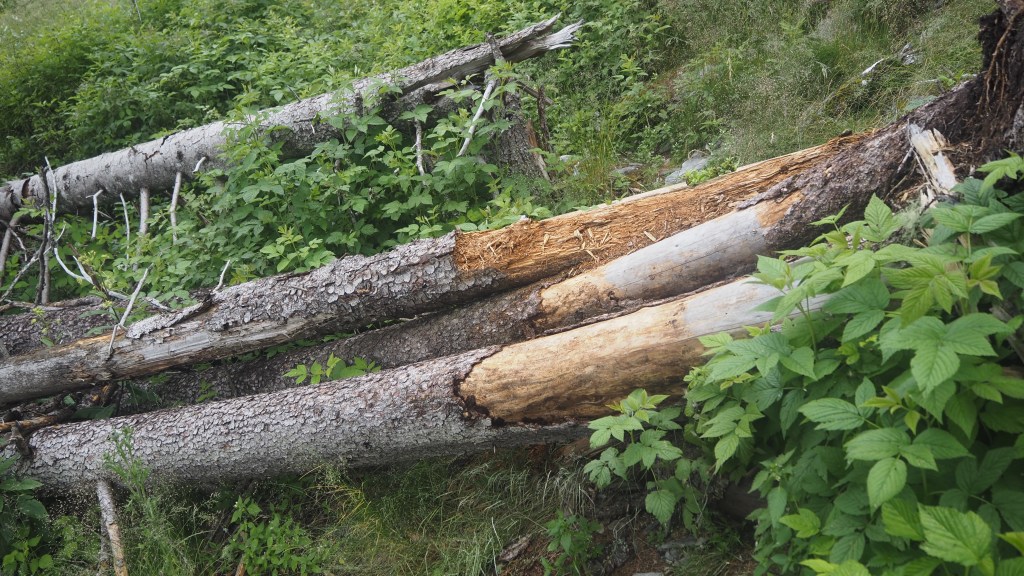
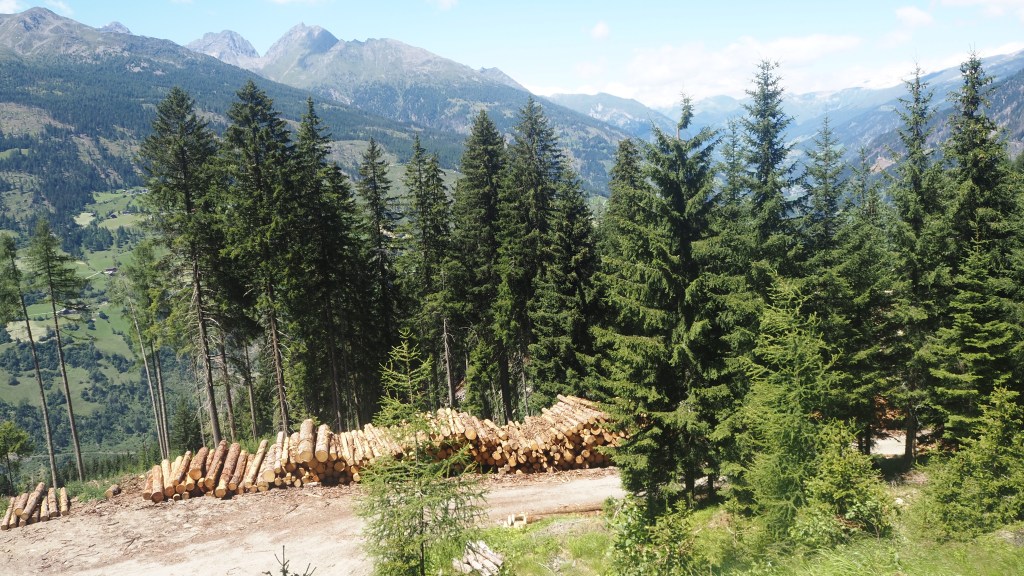
Talking of timber, the last two days have seen fallen trees (which I have had to clamber under or over), cut down areas of forest, and big timber trucks passing. Stacks of timber line the track at intervals and clearly it’s big business here. Apart from anything else most of the houses appear timber built. No doubt it makes sense to have the sawmills in the valley close to where the timber is cut down.

Stacks of timber like this lined the route at intervals

After a last couple of miles of walking on residential streets, albeit nice ones, along the valley, I finally reached the end point, the little village of Stall. Here there was no accommodation available so I had to wait for a arranged 3pm taxi pickup to take me to where I was staying, meaning I had a couple of hours wait. I met and chatted to the Austrian couple who had overtaken me earlier who were waiting for the same taxi. They told me they had finished their trip now, having done the first four days and were now returning home to be with their family near Vienna. As ever I felt guilty about how much effort people obviously not fluent in English made to communicate in English, when I knew absolutely no German. And fortunately the taxi arrived half an hour early in the end.

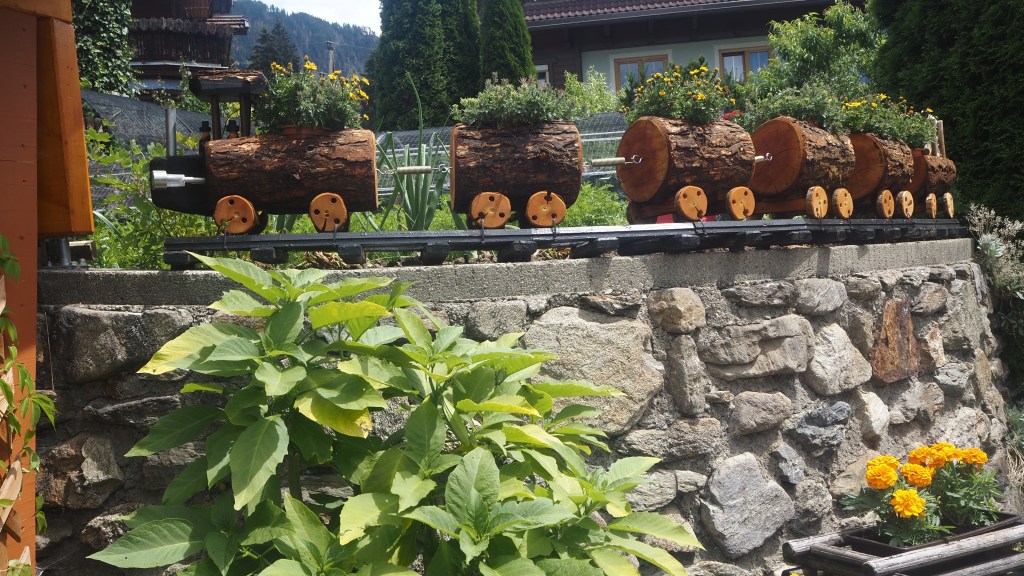
Carinthian houses seem to take pride in little decorative features, such as this one, spotted today

Tomorrow is a big day. The first I have to go both up and down in a day, climbing more than 1500 metres and then descending again the other side. It’s the first of five days on the trail graded ‘difficult’ so I will have to see how I get on. I can guarantee it’s going to be a long day , and I will be tired at the end of it.

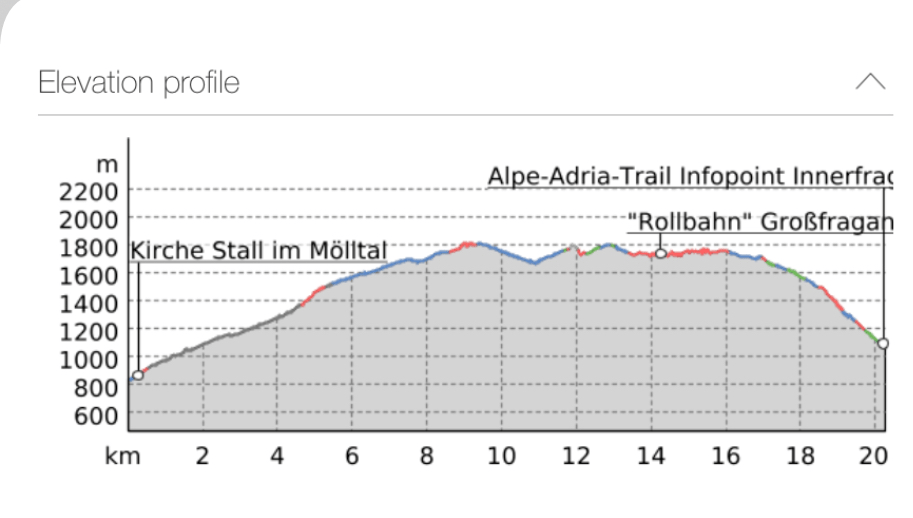
Today’s route, amounting to 13.52 km or 8.5 miles. Cumulatively I have now walked 64.9 km or 40.6 miles. After walking to Stall, I was driven to Witschdorf for an overnight stay
Today’s walk was almost all downhill, with 1158 metres of decent and only 160 metres of ascent. Cumulatively I have now climbed 2016 metres, but descended over 3500 metres, as the starting point was so high.

Hiking the Alpe Adria Trail: Day 3

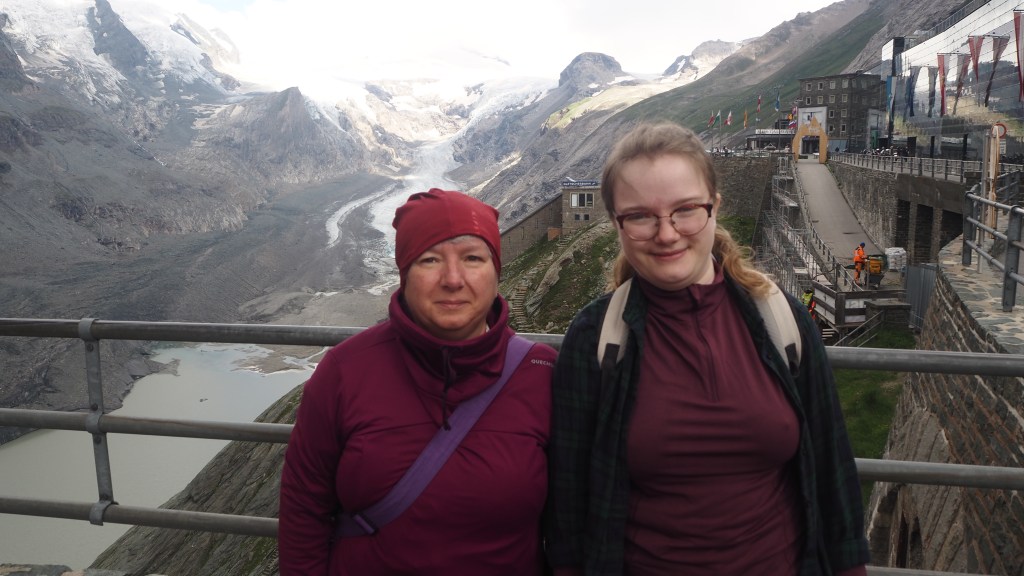
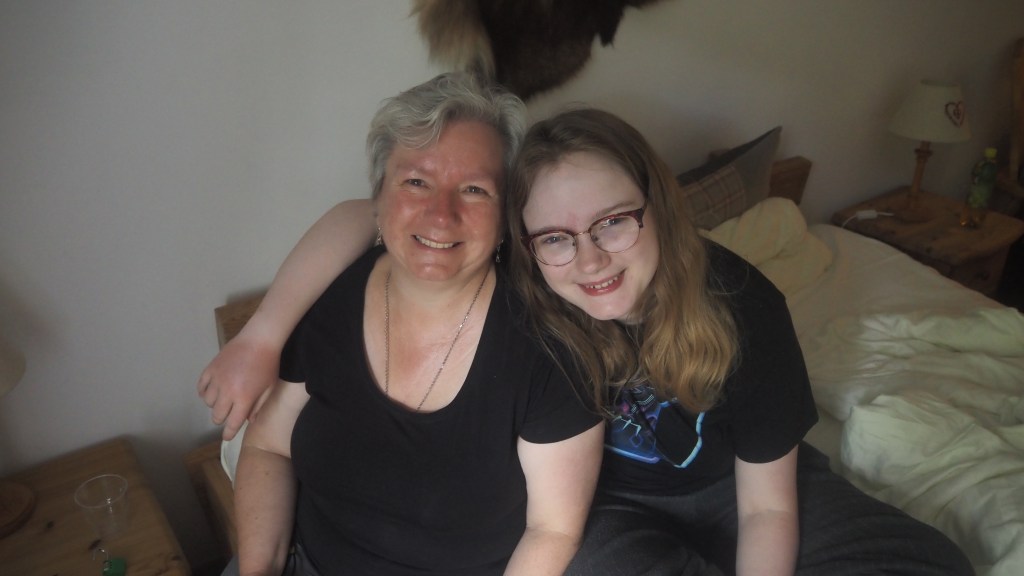
This morning I said goodbye to my wife, Jeni, and my daughter, Rachel, as they headed off from Dollach for Salzburg before returning home. It’s been lovely having them with me for my first few days, and both of them have been hugely encouraging to me and my Alpe Adria endeavour, even if they don’t really understand it! So after a fond farewell, we went our separate ways, and I’m really on my own now for the next six weeks or so.

Jeni and Rachel, just before we parted company

Today’s walk had two very distinct parts. The morning was alongside the river Moll, level all the way, along a cycle route. Although the main road was never far away, the gushing sound of the fast moving river disguised this completely. Sure, it was no wilderness walk, but it was a nice change- an easy few miles along the valley. Actually, I often think that valley walks are underrated. The view from below can show the scale of the mountains around and can, I think, be just as impressive, in its own way, as that from up high.

Walking along the River Moll
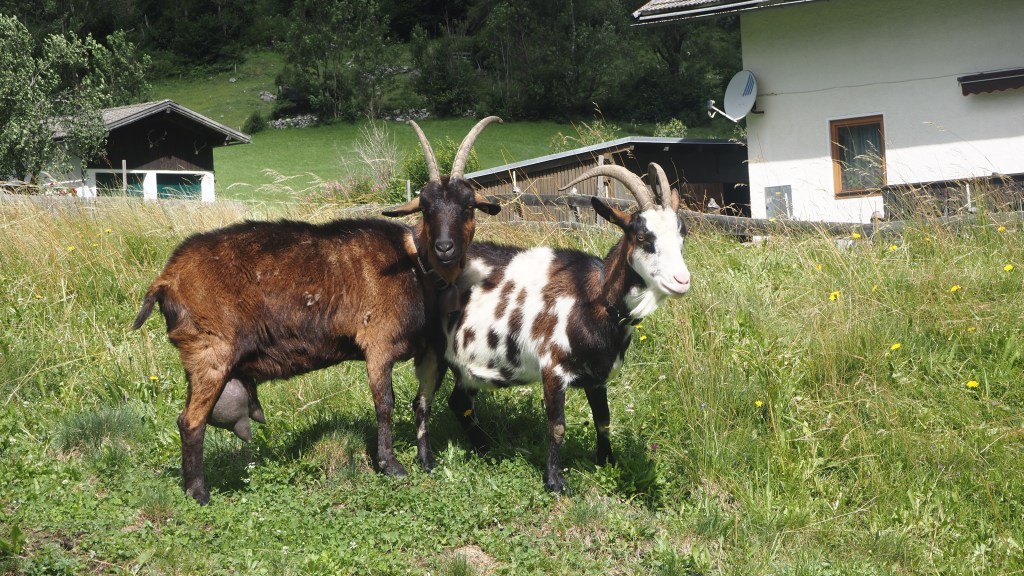
Goats and cattle all wear bells in much of the Alps, so you usually have an inkling they are nearby before you see them

After a couple of hours, and about 7 or 8 km, I finally turned off up a path through pasture to reach the little village of Mortasch. Here, as in every little settlement around, there was another high steepled church, with an immaculate flowered graveyard, set against the backdrop of the mountainscape. After this the hard work began.

A waterfall passed on the route

I knew from the guidebook that today involved a big ascent, of over a 1000 metres, above the height of a Scottish Munro. The first 600 or 700 metres up was by a switchback forest track, and although tiring was essentially a case of putting one foot in front of the other and ploughing on. Although it was sunny, a lot of this stretch was in the shade and when it did emerge into the open, it was surprisingly blowy, moderating the temperature and making the climb more manageable. Gaps in the trees at intervals gave beautiful views across the valley and back towards Grossglockner. Looking ahead there was also my first views of a jagged new mountain range, which I am sure I will see more of in the coming days.

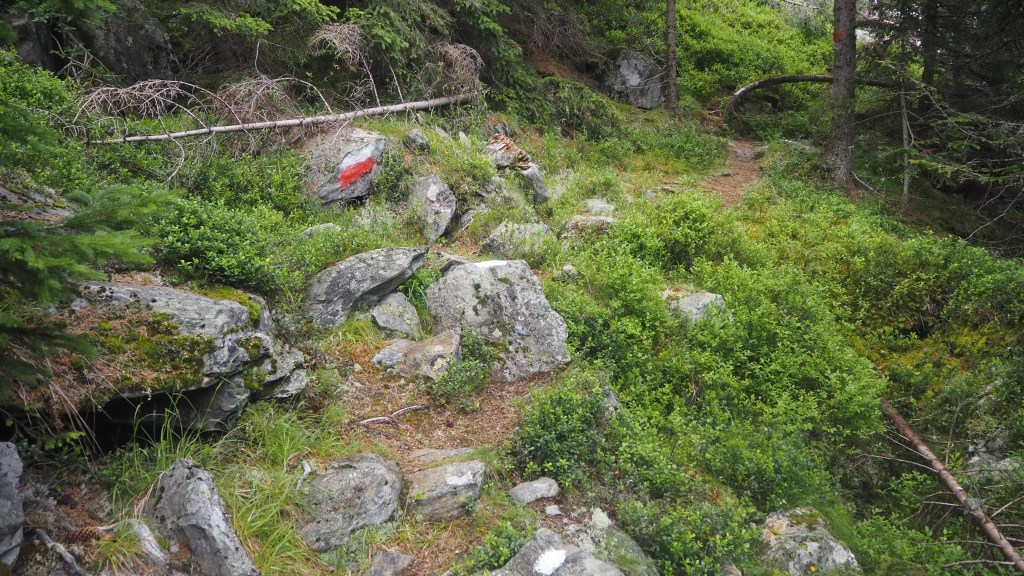
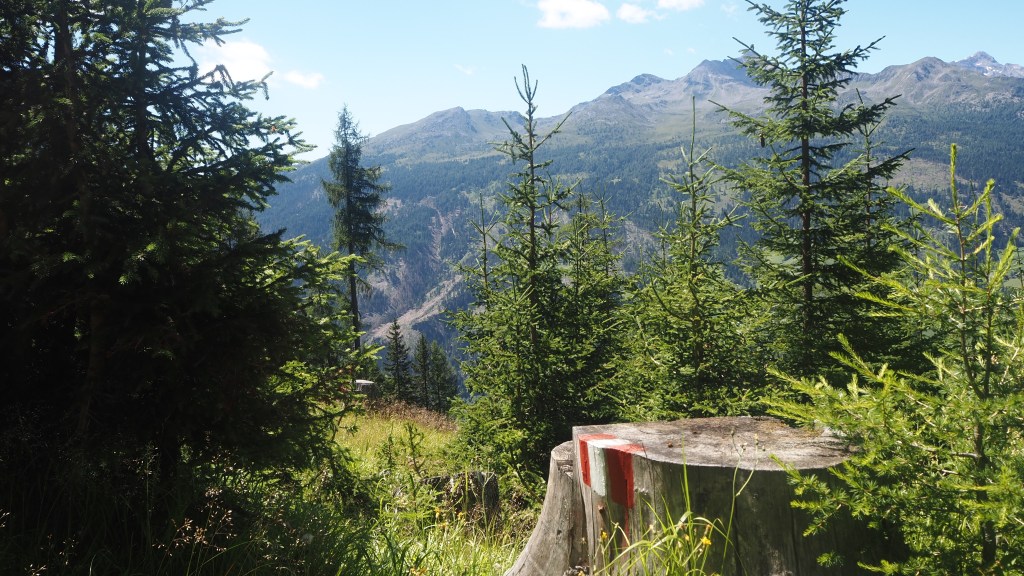
One of the views revealed when there was a break in the forest. The red and white paint splash is a standard sign for a mountain trail in Europe, and coincidentally the same colours as the Austrian flag
Some new jagged peaks on the horizon

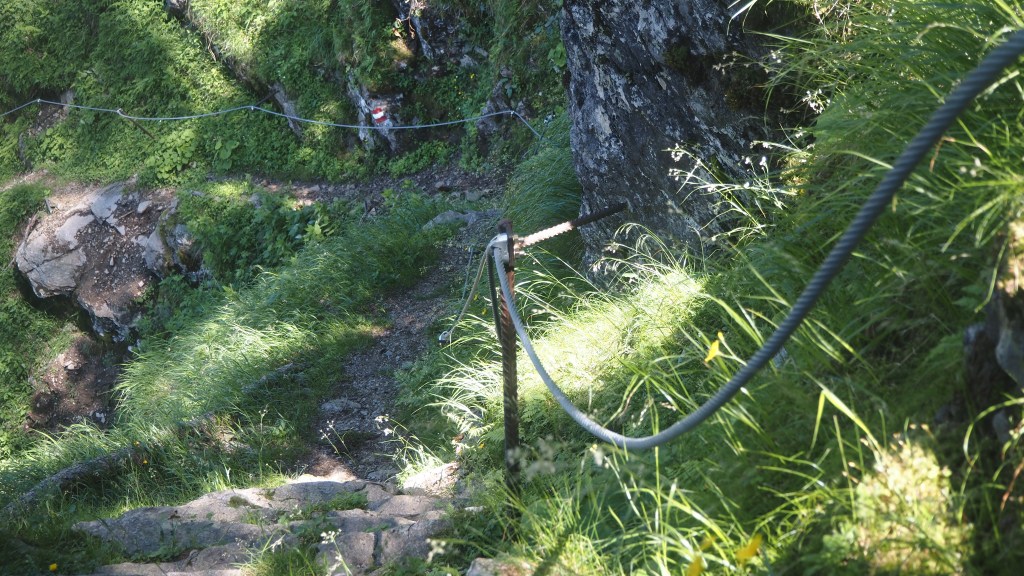
After a couple of hours the route was signposted off the track up a steep little path through the forest. I had been warned about this with the guidebook describing an hour long ‘relentlessly steep’ forest path. As it turned out, while it was steep and went on for a while, I was able to pause for breath where it was more level, and towards the end a wire handrail began as I climbed up to two perfectly sited seats, with a marvellous view. So not as bad as it has sounded really.

One of the flatter sections of forest path
And one of the less flat sections, with wire-ropes to hang onto as I climbed up. This is looking back from the top.

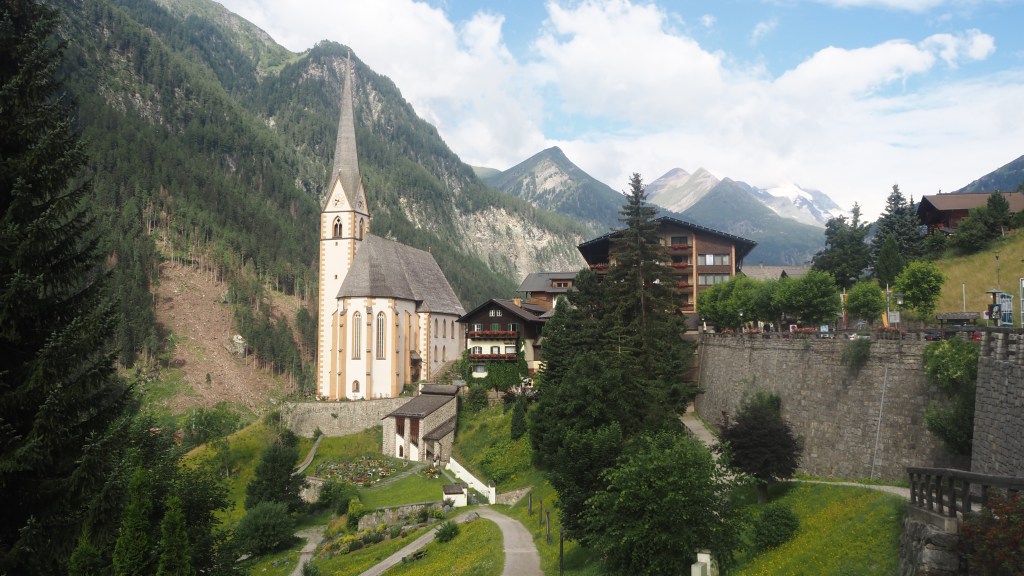
From there on the walk went up a little more and then levelled out, taking longer than I expected and needing careful attention to avoid slipping or twisting my ankle on semi buried rocks and roots. Finally I arrived at the little settlement of Martele with yet another church (apparently the highest pilgrimage church in Austria) and a stubl/guesthouse, where I was staying for the night.

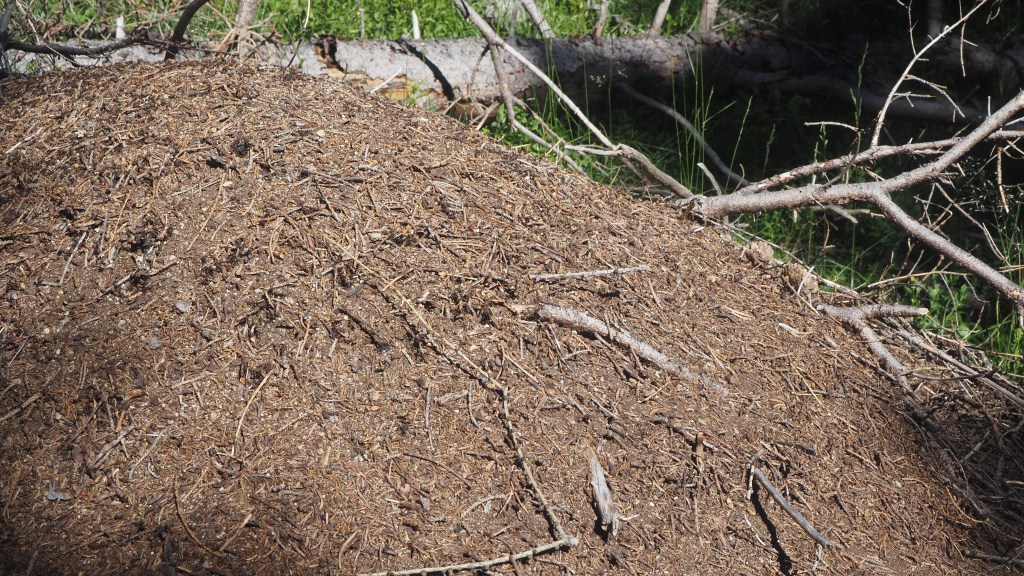
One of several huge ants’ nests I encountered on the last stage of the walk

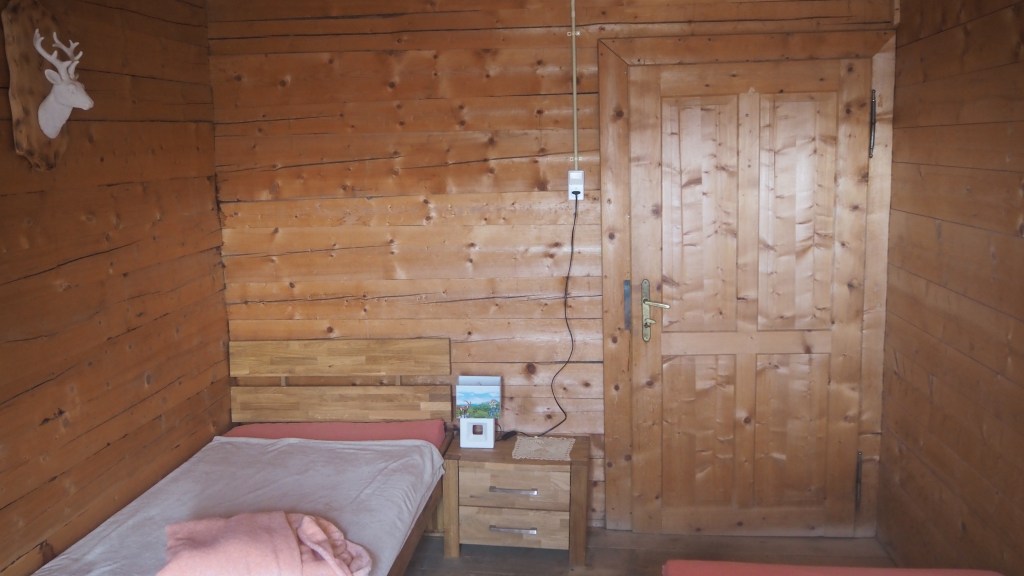
I knew my bed for the night would be a little more basic, as my luggage wasn’t being transported there, but it was probably a bit more basic than I expected. No Wi-Fi, and hence a late blog post was understandable, but having to make my own bed, and ask permission for the key to the shower which was behind a door outside, was a bit beyond my previous experience. The room itself was fine- like a little log cabin. Anyway, its setting was perfect, and the homely food they served just what I needed.

All through the day, I saw barely anyone again. The odd cyclist at the start, and then no-one else. But when I arrived at the guesthouse who should be there when the door opened than the other walker we had met on day one, who was carrying all her own gear. She said she had found today hard, which I can imagine, as it had been the most physically exhausting yet, and she had a heavy backpack. But she had still beaten me there, although she could have started earlier.

I had managed to finish the 20 km in about 7 hours, in line with the suggested time, with a heavier bag than normal as I had to carry overnight stuff to Martele. So I’m pleased that at least when mainly on the level or going up, I’m broadly in line with target times, even if, due to inherent caution, I’m much slower than average going down. Tomorrow is meant to be an easy day, but is almost all down, so we shall see how I do.

My basic cabin for the night
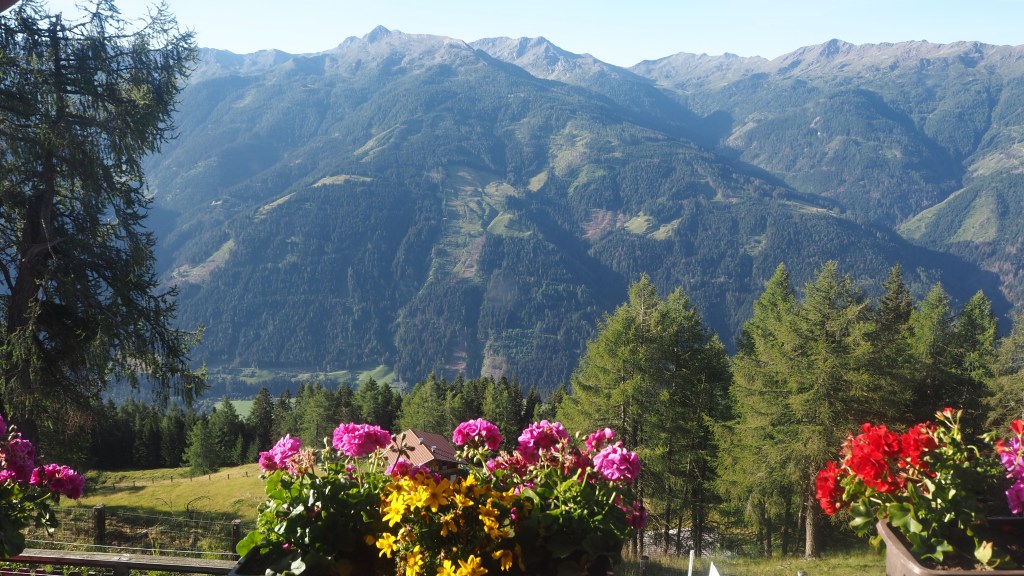
The view from the cabin window
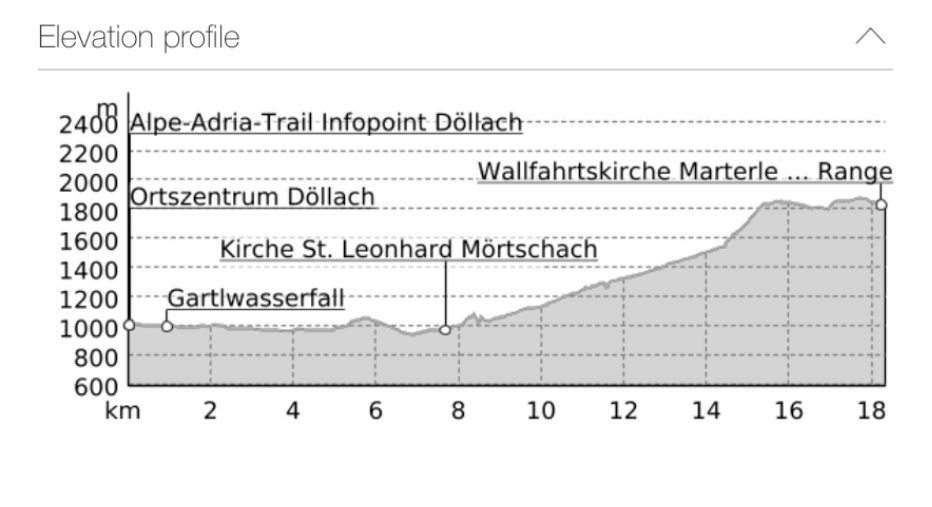
Today’s walk came to 20.76 km, or 13 miles. Total distance walked so far is 51.38 km or 32.1 miles
Today’s gross ascent was 1031 metres, descent 267 metres, net height gain of 812 metres.

Hiking the Alpe Adria Trail: Day 2

View across the Moll valley, along which I walked for most of the day

The second day of the trail was very different from the first. Yesterday we walked down from the high, rocky alpine landscape, then descended into the forest. Today was mainly in the level beneath the forest, of pasture, following the Moll valley, parallel, but high above, the main road, walking between farms.

Heiligenblut, where todays walk started

The first hour or so was mainly up, and for longer than I expected, annoyingly because of a quite lengthy detour uphill caused by a collapsed footbridge over a river gorge. I stopped to ask the way of a farm worker, and with a few words of English and German common to us both, plus some finger pointing, I managed to gather which way I had to go.

Much of the walk today walked between hillside farms

After that, much of the day consisted of easy walking along farm roads, and narrow connecting footpaths along the tops of pastures and through little woods. The ups and downs, apart from at the beginning and end, were mainly short, but no sooner did you go up, than you came down again. It was a bit like walking a coastal path.

There were big wide views across the valley to the tall, three part cascades of the Jungfernsprung waterfall, back to Heiligenblut, and forward along the valley. The farms seemed close together, so were probably small, and although I saw some goats and geese, there were no encounters with cows today.

The Jungfernsprung waterfall, with its three steps , was visible across the valley for much of the day

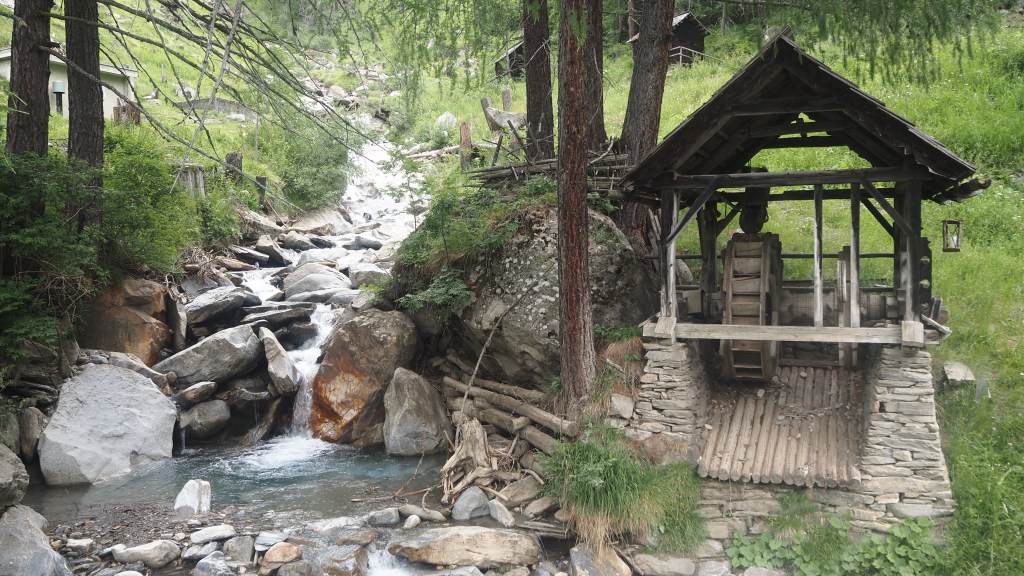
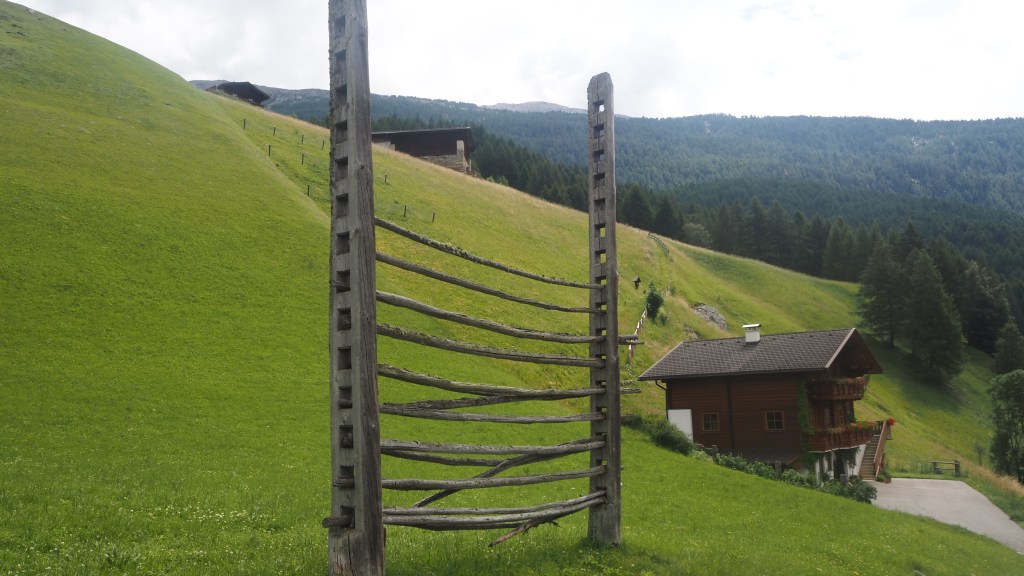
Notable features included a couple of waterwheels; and numerous examples of drying racks, used to draw grass for winter straw for animal feed.

One of several water mills I passed
There were lots of these drying racks on the hillside on my walk

Yesterday we’d been told by our taxi driver that very few, maybe 5%, of walkers on the trail hiked the while route in one go, with most spending a week or two each year to complete it. We did however meet one young woman who was backpacking the whole route. But today I saw only one other pair of walkers, and have no idea whether they were walking the whole route or not. With peak holiday season yet to start, the hotels, towns and paths are still quite quiet at the moment.

Largely the weather behaved. Although I had my first bit of light rain on the trail today, mostly it was warm and sunny. The heavy rain only arrived after I’d already got to the hotel in Dollach, and popped out to meet Jeni and Rachel who’d just arrived by bus.

Because of the diversion, the total distance today clocked up as 13.9 km (8.7 miles), a couple of km longer than expected, but still short, and with only 510 metres of ascent, it was, as expected, an easy walk, and I was finished in around 4.5 hours, only a little longer than suggested in the guide book.

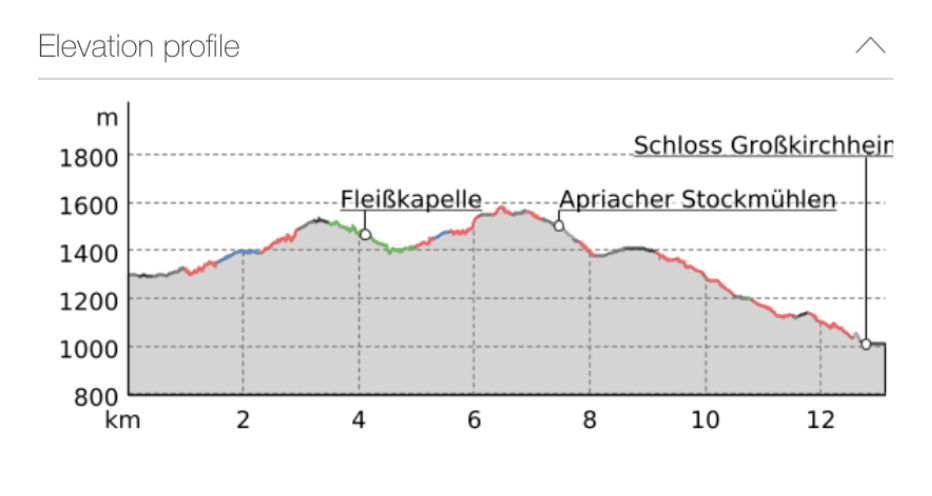
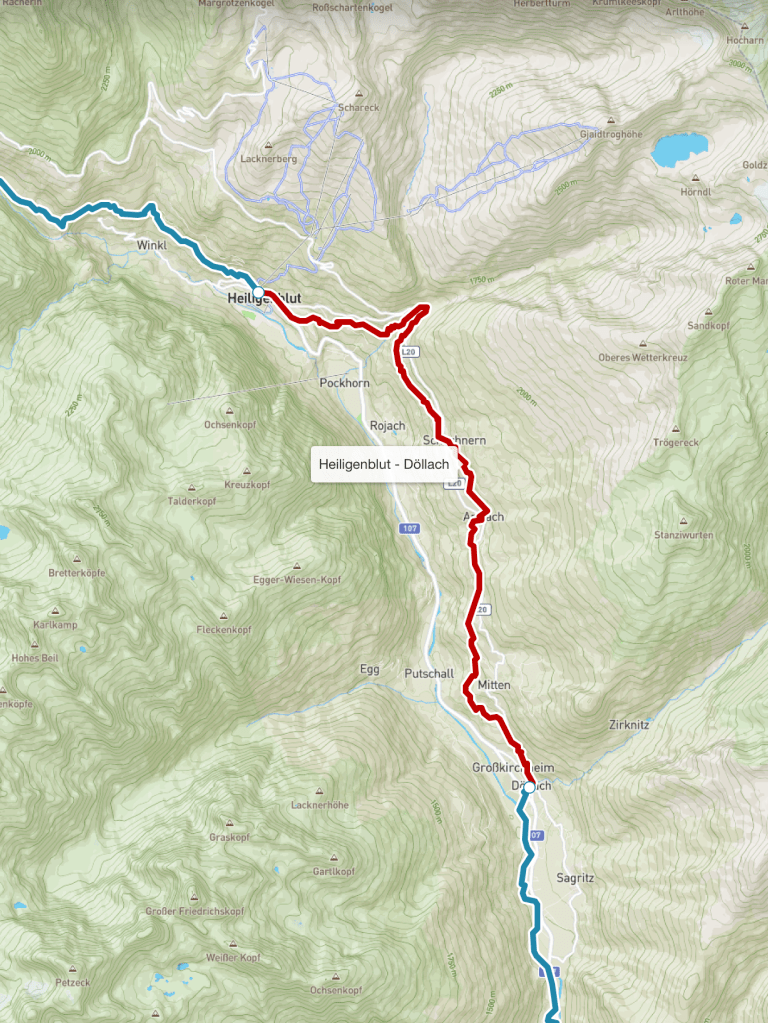
Todays walk took me from Heiligenblut to Dollach
So far I have walked 30.6 km (19.1 miles), and 777 metres up over the course of two days. Still a long way to go!
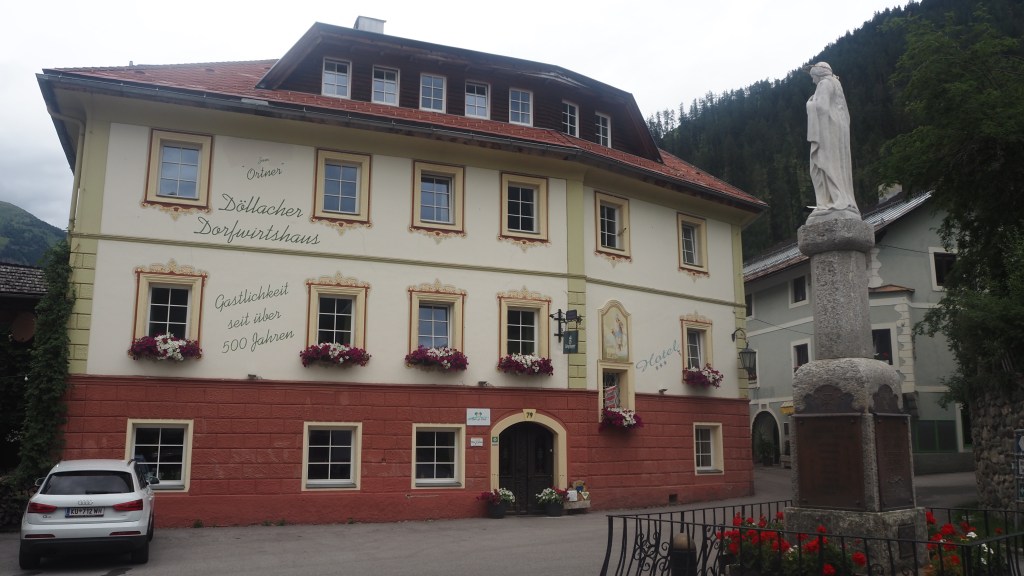
Our hotel in Dollach

Tomorrow, after a final meal together, Jeni and Rachel are off to Salzburg for a few days, and I’ll be on my own until Jeni returns for the end of my journey, in another five weeks or so.

Hiking the Alpe Adria Trail: Day 1

Finally, the day had arrived. The first day of my long anticipated journey along the Alpe Adria Trail. It almost seemed like it would never happen, after two years of Covid restrictions, and seemingly never ending travel restrictions of one sort or another.

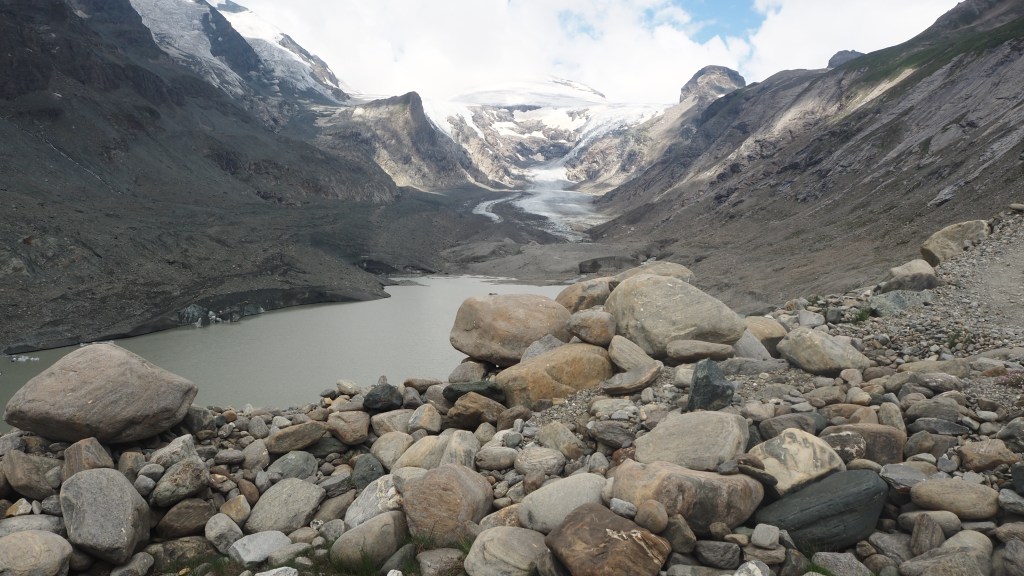
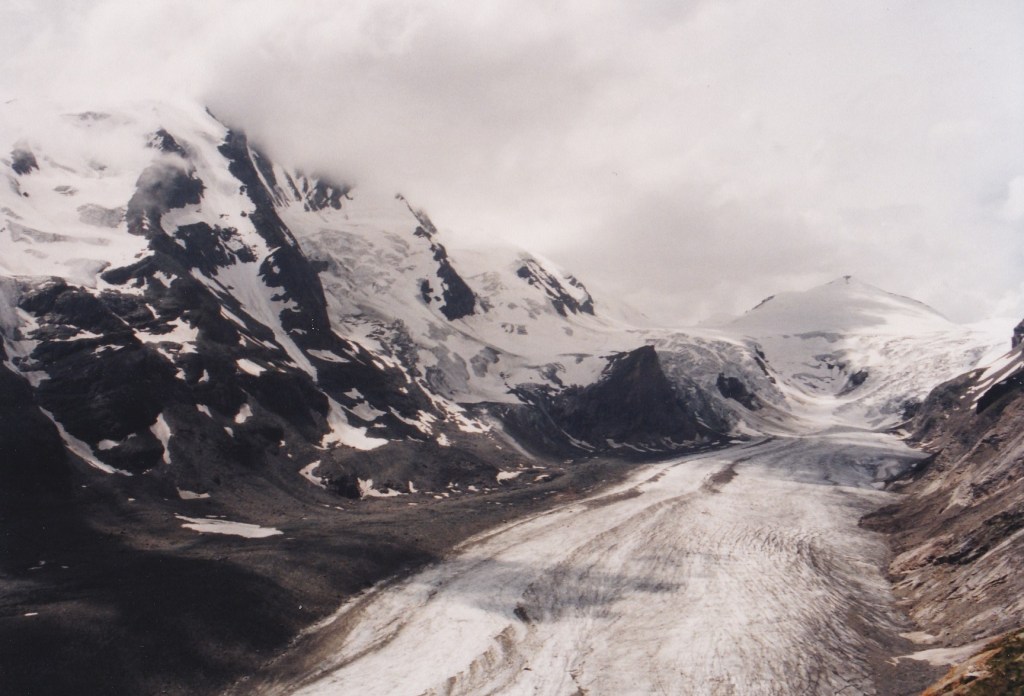
And what a spectacular starting point this trail has. Over 2300 metres above sea level, the Grossglockner road in Austria’s Hohe Tauern national park may be one of Austria’s top attractions, with around a million visitors each year, but nothing can detract from the natural splendour of the high alpine setting, the snow covered mountains tops, the Pasterze glacier and the blue-green glacial lakes.

Seeing me off, and walking with me on my first day, were my long suffering wife, Jeni, and my recently graduated daughter, Rachel. All of us had visited this spot before, although Rachel can hardly be expected to remember, as she was only two years old at the time. In the intervening twenty years, the glacier has diminished, but it and its surroundings have lost none of their splendour.

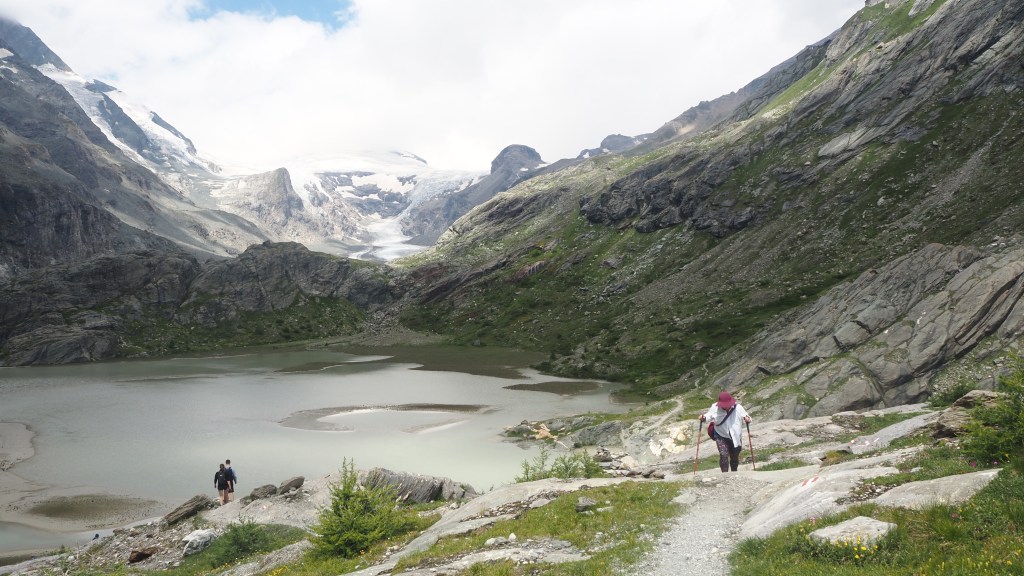
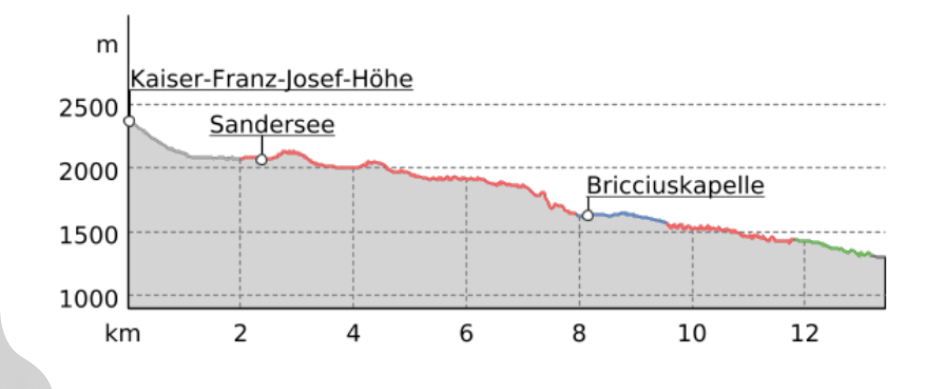
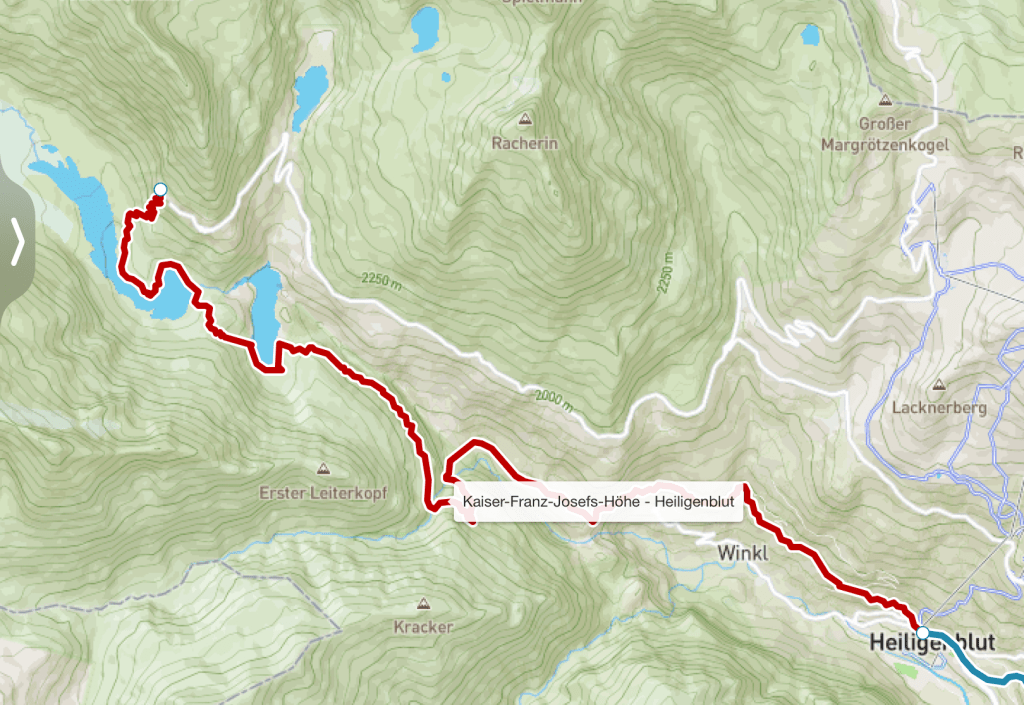
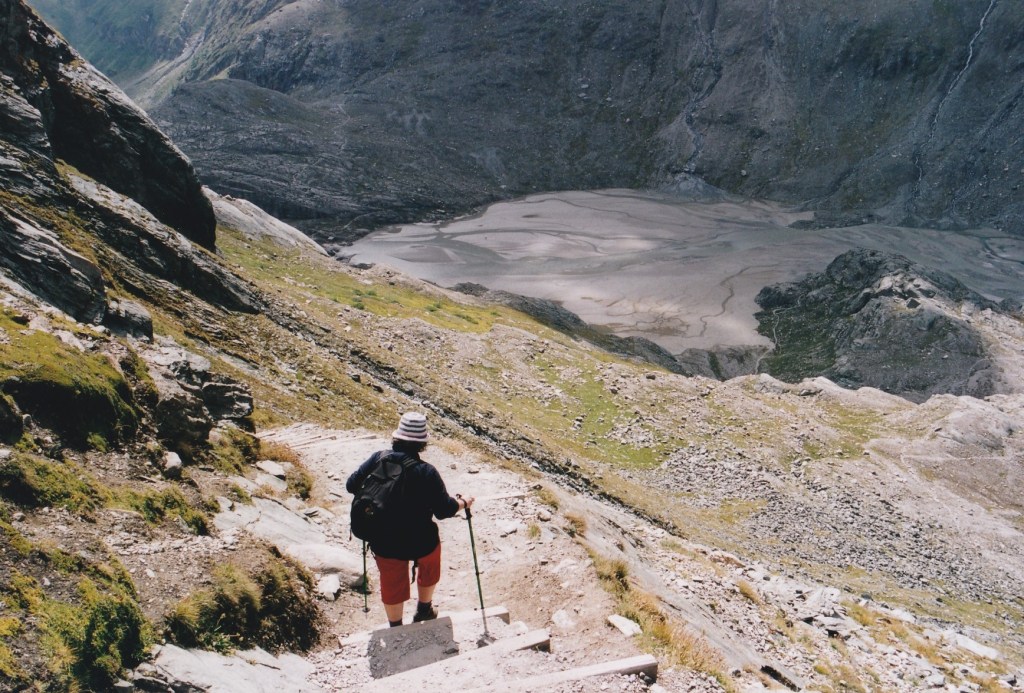
The walk began with a long steep, but stepped descent to the level of the glacial lake, Sandersee. Admittedly we could have taken the gletscherbahn funicular to save half an hour but that would have seemed like cheating right at the start!

After climbing down to the lake, with its little iceberg like glacial remnants, after crossing a little suspension bridge, it was not long before we were climbing again. All around us were pretty alpine flowers, colourful butterflies, set against the backdrop of the massive snow tipped mountains. The expansiveness, the space, is difficult to describe if you have not been there. Even when you can see the Grossglockner road, which brought us there, humanity seems small and insignificant besides the mountains, and the colours of the rocks, grassy slopes, and water complement each other perfectly.

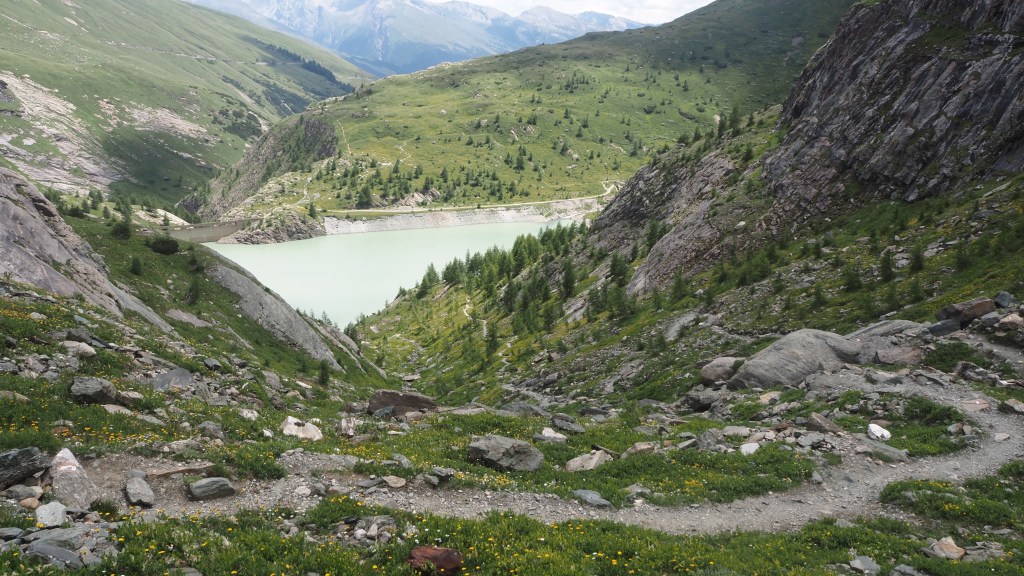
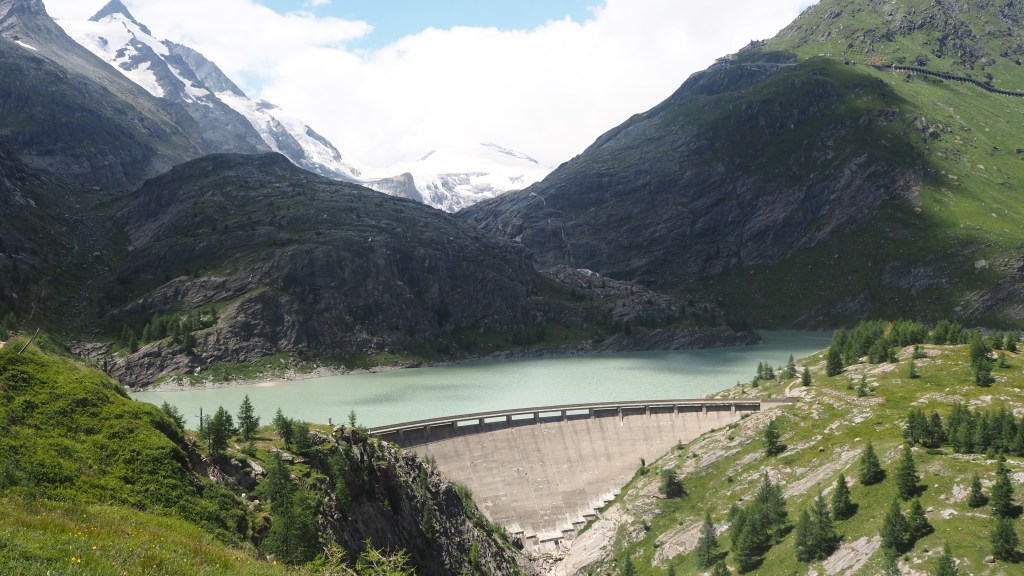
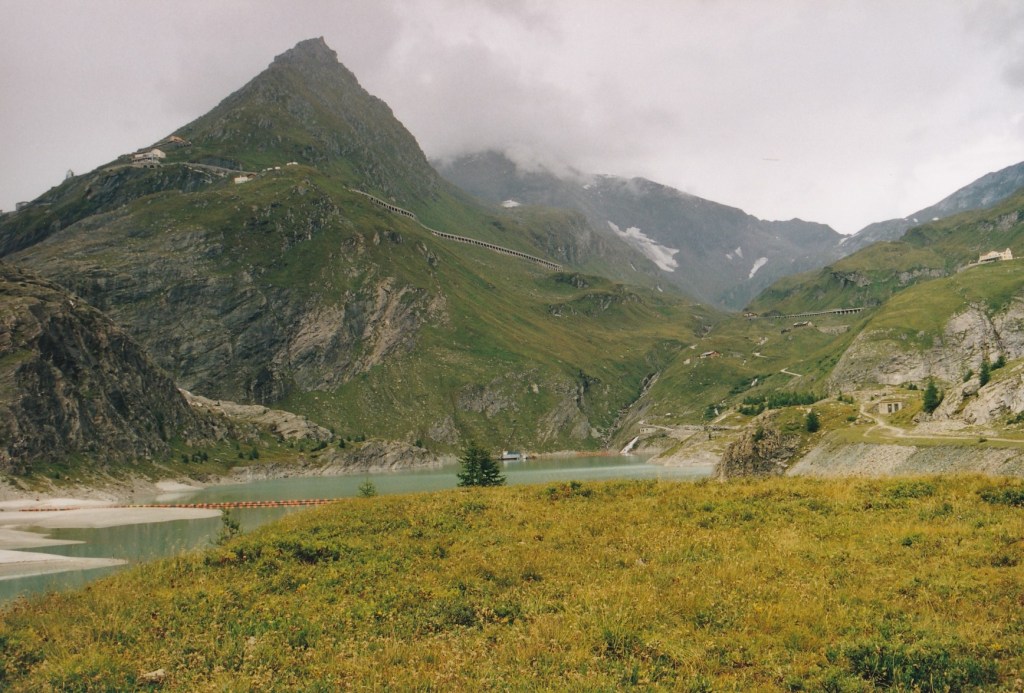
After a stiff climb, it was down to the dammed reservoir of Stausee Maragaritze. Having a picnic near here we saw a couple of marmots nearby.

The afternoon’s walk took us up from the lake and then down the other side through steep forest. Then as the path levelled out, we were confronted with two cows heading towards us. Us and another family made space for them as the cows decided what to do, one heading up towards fresh grass, another turning round while we followed, but not too closely for obvious reasons. Eventually we reached an open area where were able to pass.

Further long slow descents followed, interspersed with easier bits of track walking, some waterfalls, and a little isolated chapel.

By the time we reached Heiligenblut we had been on our feet for eight and half hours – not the five optimistically referred to by some ( and the three and a half at the first signpost!). All of us are particularly slow going down, and there was over a thousand metres of descent today, plus 267 metres up, as well as a total distance of 16.6 km , so we think for a first day that wasn’t bad. I’m usually more likely to meet the expected times going up, funnily enough.

As a result of our long day ( and that Jen lost one of her walking poles towards the end, as it fell down a hill) Jeni and Rachel look like they won’t be joining me walking tomorrow. But they will be staying with me another day which will be nice. And I have another 36 days to look forward to.

Day 1, 16.6 km (10.4 miles) and over 1000 metres of descent

The Alpe Adria Trail: my journey approaches…

It’s been a long wait. Three years since I first decided to take it on. After false starts next Wednesday should see me finally start my walk of the Alpe Adria Trail.

The Pasterze glacier, at the start of the Alpe Adria Trail, in the Hohe Tauern National Park, Austria.

So I thought I’d explain what it’s all about, dispel a few myths, try to explain why I’m doing it, and put in all in context.

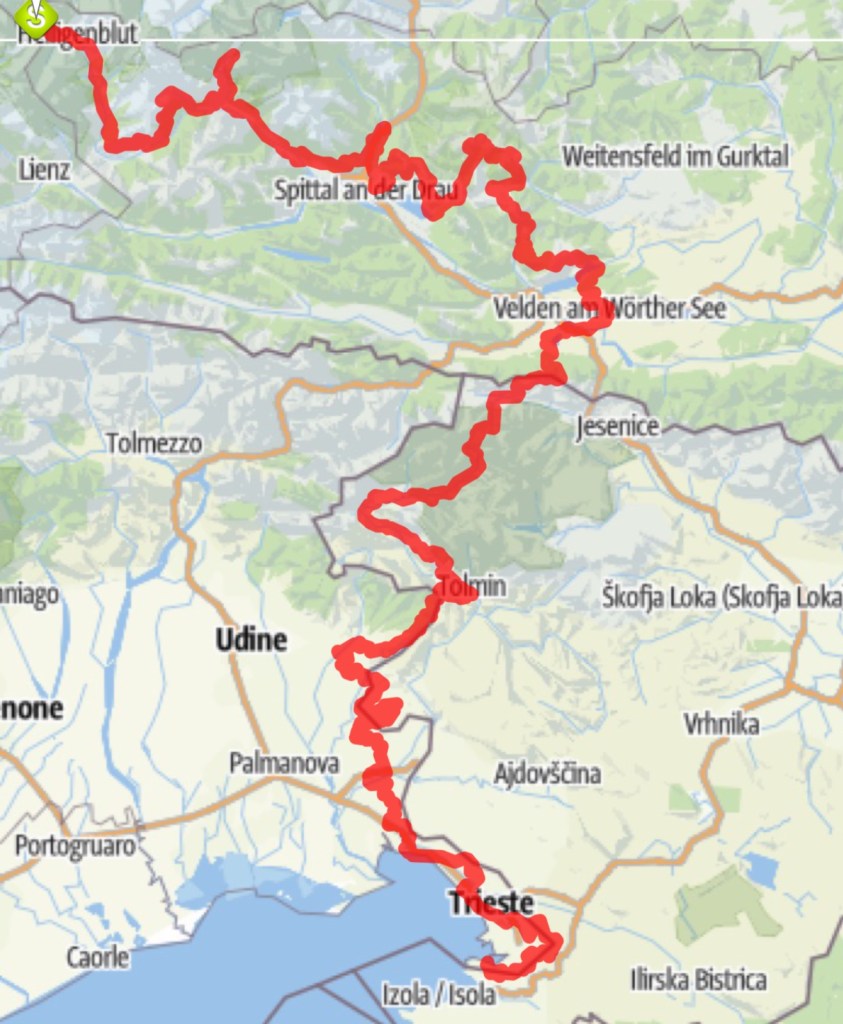
First, what it’s not. This isn’t walking the Appalachian Trail or the Pacific Crest Trail. I’m not carrying all my own gear. I’m not camping. Most of all I’m not walking thousands of miles. The Appalachian Trail is 2190 miles, the Pacific Crest 2663 miles. By contrast the Alpe Adria Trail is around 420 miles. It’s more equivalent in distance to a modern day Camino, such as the Way of St James, or walking from London to Edinburgh. So still a long way, but nothing like some of the international epic routes.

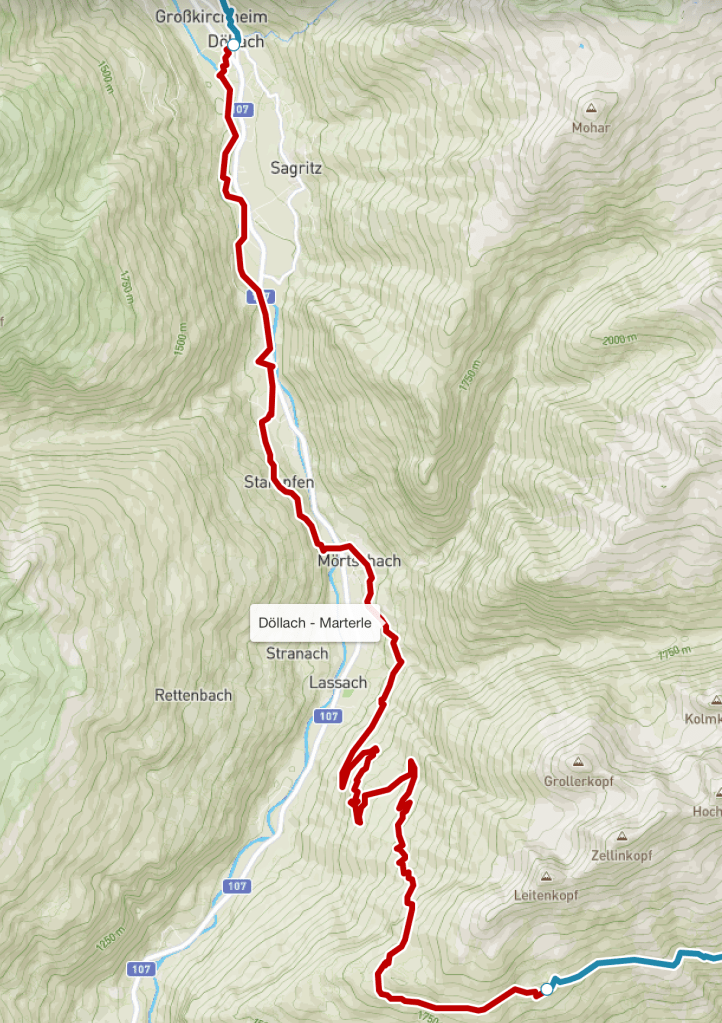
The main Alpe Adria Trail route, from Heiligenblut in the Alps to Trieste on the Adriatic, travelling through Austria, Slovenia and Italy
Near the start of the route (Margaritze Stausee)

I’m not forging my own route across wilderness, or clambering up precarious routes to summits. I’ll be following a route established about ten years ago jointly by the local tourist boards of Carinthia, Slovenia and Friuli Venezia Giulia.

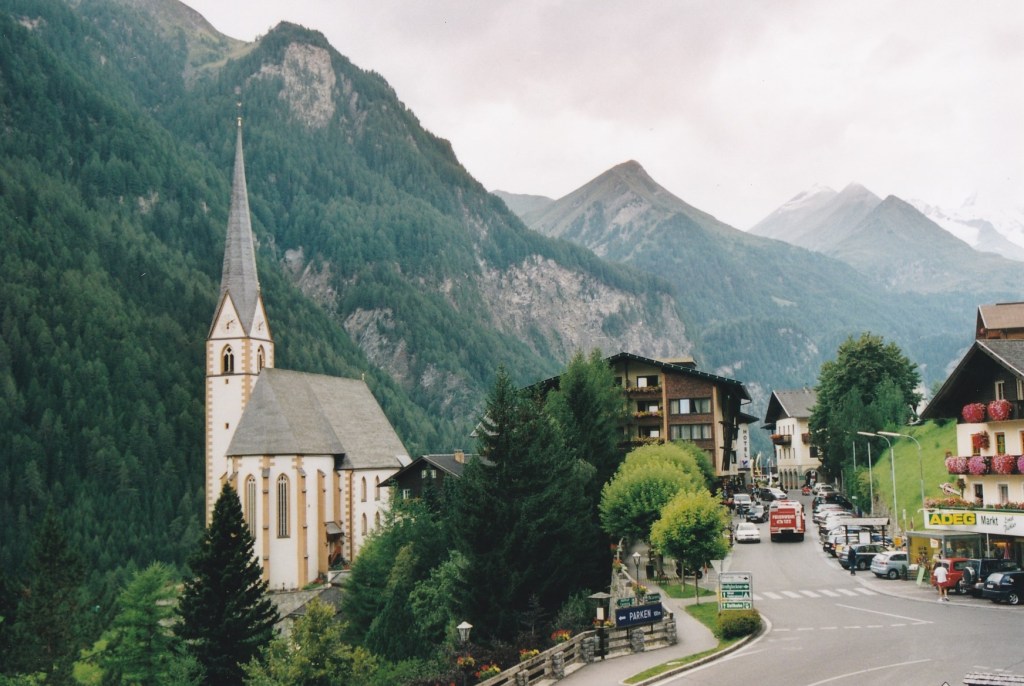
Heiligenblut, one of the many mountain villages I will pass through

So I get a nice hotel bed (almost) every night, and where I don’t, a relatively comfortable Austrian mountain hut. But the down side of this is a lot of up and down to reach the little mountain settlements in the valleys. And I mean a lot.

To put it in context, according to my guide book, over the course of the trek, I will climb over 27,000 metres, descending almost as much (the start is pretty high up). That’s equivalent to over three Mount Everests.

Several days exceed the climb to the summit of Ben Nevis (1345 metres), twelve days exceed climbing Snowdon (1085 metres). Mostly this on tracks and paths and shouldn’t be technically too difficult, but it sure will be tiring.

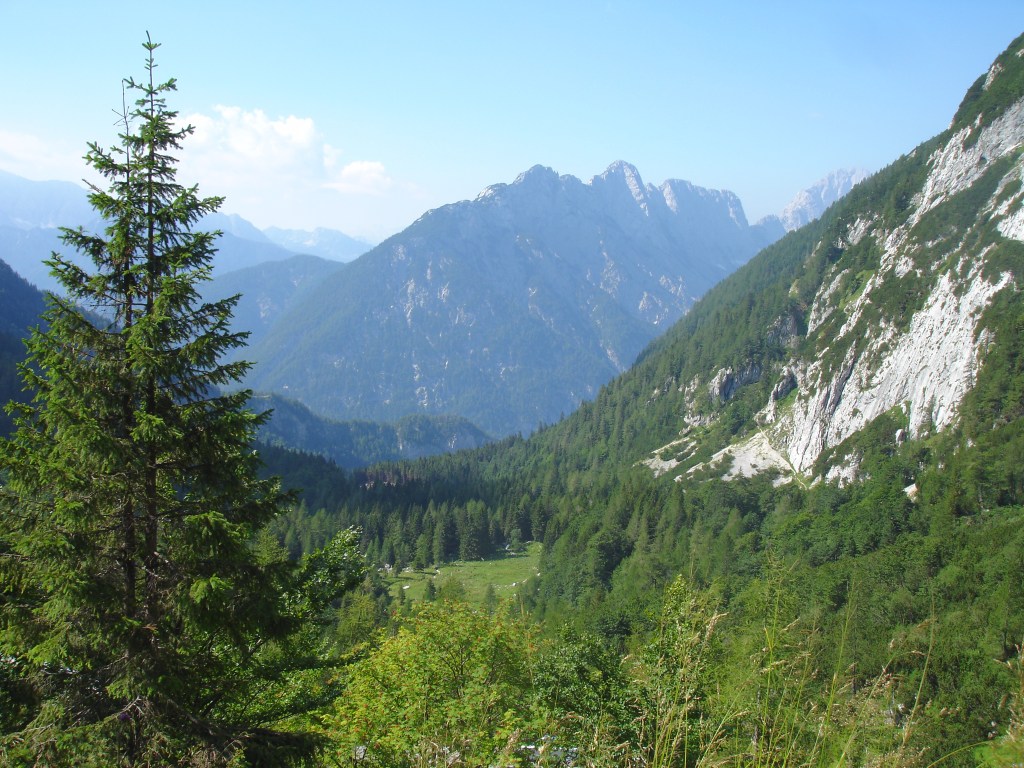
Near the Vrsic pass in Slovenia

My baggage will be driven on to my next hotel stop each night (with three or four exceptions). So I won’t be carrying one of those big backpacker rucksacks, just an ordinary daysack.

The other challenge is I’ll largely be doing it on my own. Originally, friends and family were going to join me for about half the route, but it hasn’t worked out for people this year, and my caution about Austrian entry requirements, following two false starts, has led me to starting earlier in the summer than I’d originally intended. I’m used to doing day walks on my own, or short walking breaks and am comfortable in my own company and generally confident in my own abilities. But it will be a different challenge spending nearly 35 days on my own.

My wife Jeni, starting the Alpe Adria trail in 2002, although she didn’t know it . The route had yet to be created. Jeni and my daughter Rachel will be joining me for the start of the route.

Modern technology will help. Wi-Fi and 4G should enable me to have frequent video calls with the family, a Garmin in-reach mini and gps should help me from getting too lost and enable me to call help in any emergency, and iPads, phones and ebooks should keep me entertained in the evenings.

I’m sure I will also meet and chat with some interesting people on the way. The impression I get is that the Alpe Adria Trail has yet to take off as a well known and popular challenge like the Appalachian or Caminos, but I still may meet some ‘thru-hikers’ and certainly others doing day walks or stretches of the trail. While I don’t speak any of the languages of the countries I’m passing through, English gets you a long way these days.

The Julian Alps in Slovenia

Doing a trek like this is bound to be an adventure. Seeing new sights, experiencing new places and people, walking further in one go than ever before are all exciting. Much as you can plan, luckily you never know what doing something like this is going to be like until you do it. The weather is one big uncertainty. Will it be too hot? Will I be caught on the mountains in a storm? I have to be prepared for most eventualities. Am I fit enough, can I avoid getting injured? That is always a concern, but I’ve prepared as much as I can, not least with having walked nearly 1000 miles already this year, including just completing the Two moors way, hiking in Cumbria and La Gomera earlier in the year. And you would not believe my medicine chest!

The route passes through three countries-one of the reasons undertaking it in 2020 or 2021, with the myriad of ever changing covid restrictions, didn’t work out. Alongside the changing scenery and climate, the cultural, historical and linguistic changes as I progress along the trail should also be interesting to observe.

Why am I doing it? Why do you do anything? I love the mountains, but I know my limitations. I’m not getting any younger, and I now have the time and resources to do it. My wife is very understanding and encouraging. We’ve even arranged that my trek will end on our 25th wedding anniversary when she is flying out to meet me. What could be nicer?

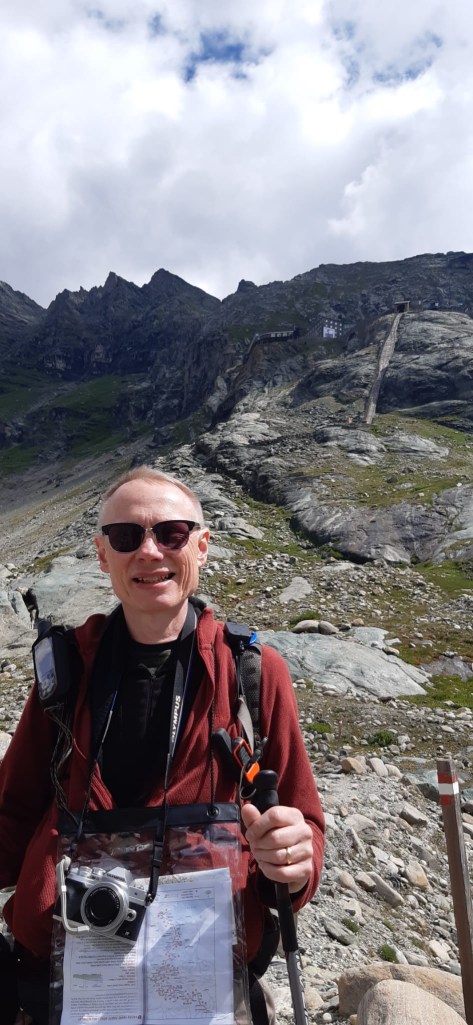
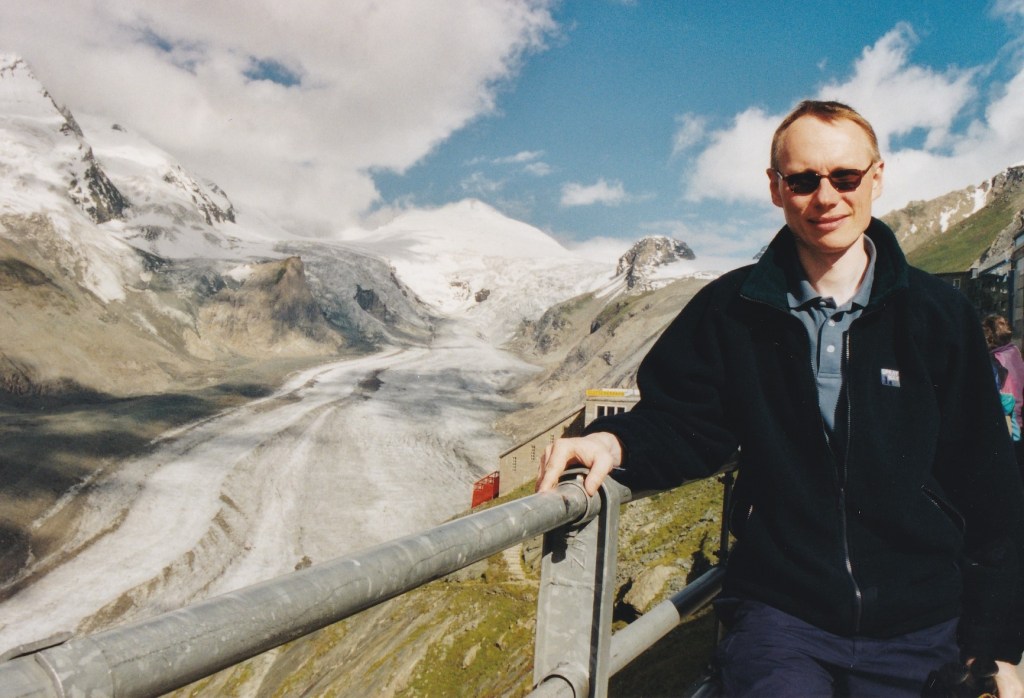
Twenty years ago, this is me at the start of the route at Franz Josef Hohe. In another twenty years I know I won’t be able to do this sort of hike, so there’s no time like the present

The fund raising for helping save the endangered pangolin is also going well. Having the support of family and friends, and knowing that you are helping in modest way to protect these poor creatures is an extra motivation. At the time of writing people have generously contributed £460 towards this cause, and it would be great if we could push this total even higher once I’ve started the trek. If you enjoy reading this blog, care about pangolins, or just want to give me some moral support, and haven’t already, please do contribute (the easiest way to do this while I am away is through my just giving page https://justgiving.com/fundraising/larry-honeysett. (if you’d rather not use this please do get in touch with me and we can find another way). I’m really grateful for everything people have given so far.
Another view of Margaritze Stausee

No photograph, certainly not mine, can hope to convey the grandeur and natural beauty of the mountains and I’m no Ansel Adams, but for those like me captivated by the mountains, these photos of the couple of parts of the trail I’ve previously walked before should give an inkling of why I’m embarking or this journey. I can’t wait.

Walking across Devon from coast to coast: Day 10

The last day of the Two Moors Way is one of the real highlights. Open moorland, trickling rivers, deep wooded gorges, plus a real sting in the tail – a big climb and descent – before you arrive at the alpine-like coastal town of Lynmouth.

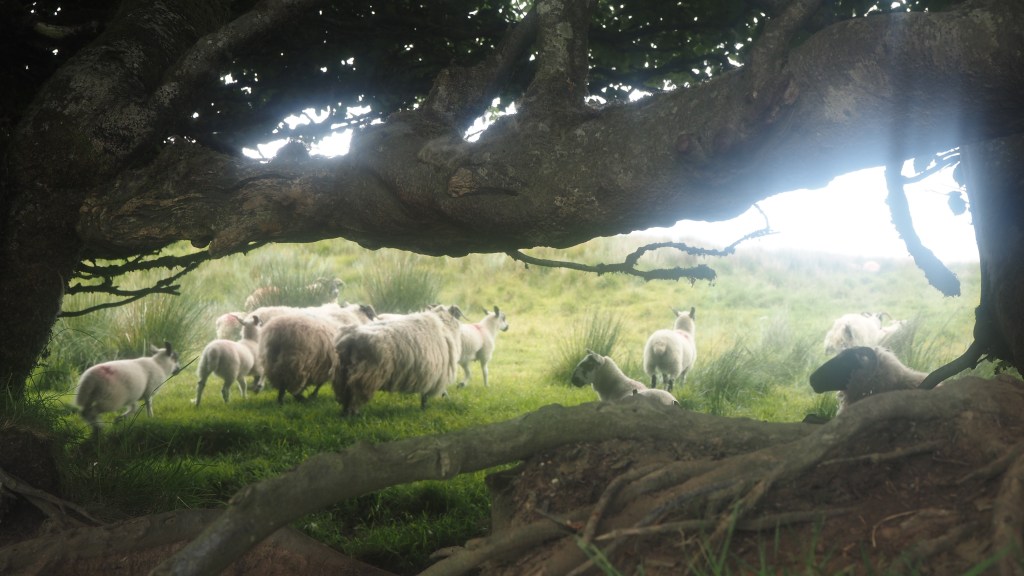
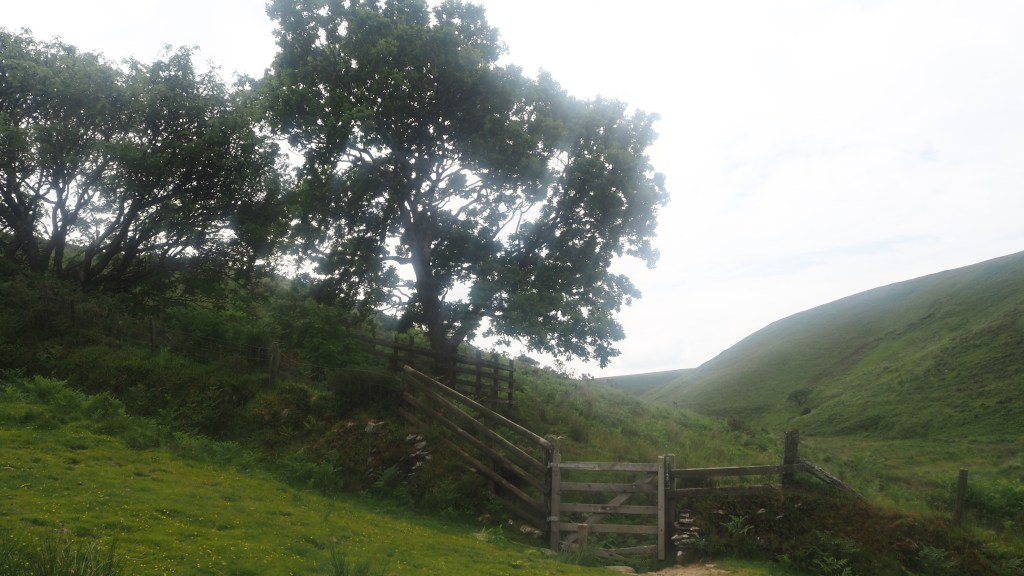
Sheep shelter from the strong sun under trees on Exmoor

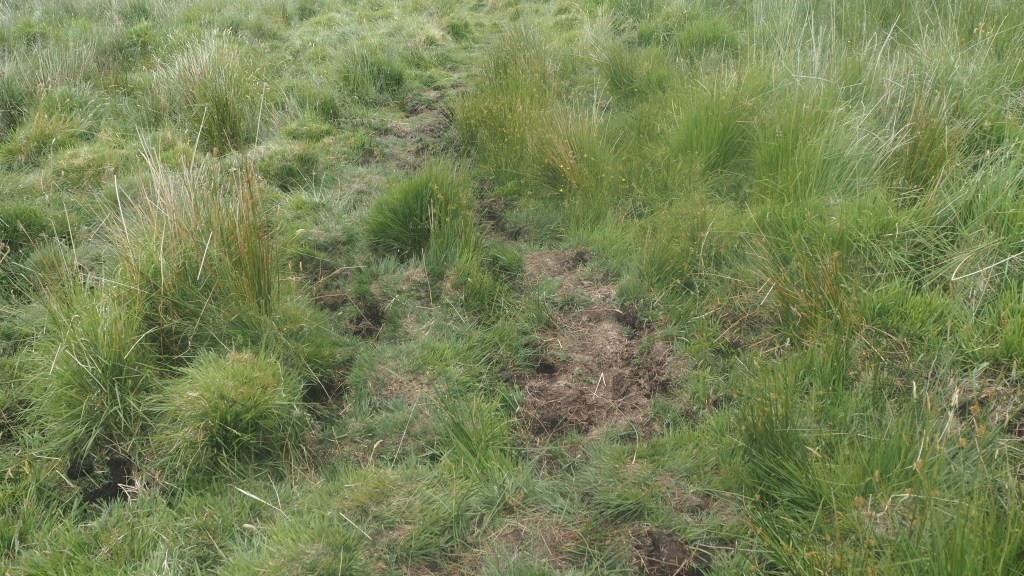
This morning we resumed our walk from Simonsbath, climbing up onto the open moor. The guidebook had warned us that the next part of the route was ‘featureless’ and true enough it was. Not surprisingly, it also turned out this meant that it was pretty much pathless. While there were some sheep tracks that we found in places, none of them really went quite the right way. So for a while we just followed our gps track across long grass, reeds and thistles, reaching a point known as Exe Head where the path miraculously reappeared.

A not so clear ‘path’ on Exmoor

To be honest this is the sort of situation where I wouldn’t be without a gps. I know many people can still navigate with map and compass- I can but can’t say I’m supremely confident with it on featureless terrain- and many use phone apps, but I really wouldn’t rely on those alone on places like Exmoor, without at least downloading rather than relying on 4 or 5G for your maps. You could find yourself suddenly mapless due to loss of signal or a dying battery.

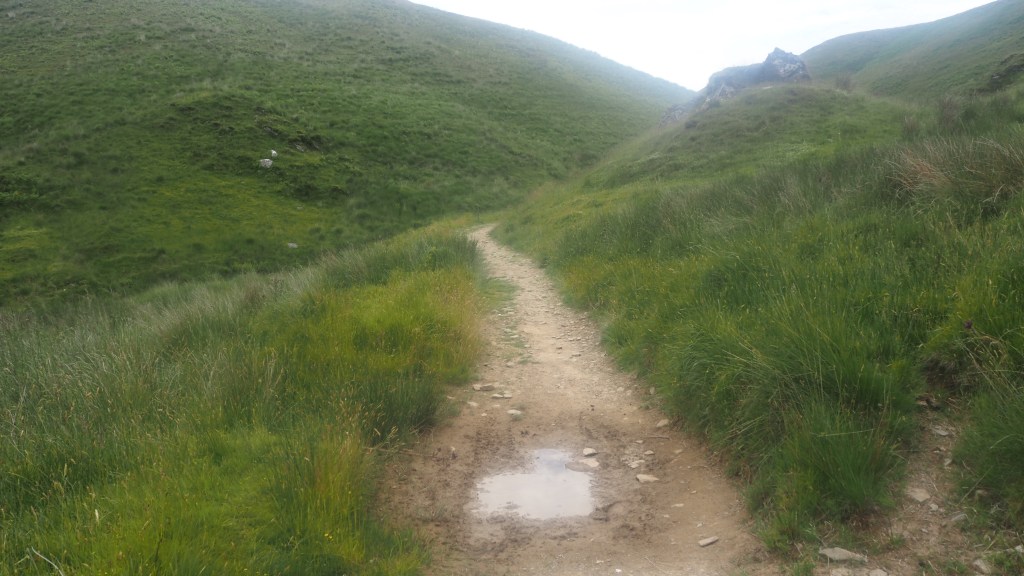
Luckily for us the forbidding descriptions in the book for the next part of the walk – of damp and difficult ground – turned out not to be a problem on the day we were there, as the ground was so dry. Certainly there was the odd puddle, but really nothing to what we’d come to expect on a moor.

A clear path on Exmoor

After passing the ‘Hoar Oak’ we crossed back into Devon and followed the long flat Cheriton ridge, before finally leaving the open moor, and following a stony track downhill to a lovely level walk by the river, part of the National Trust’s Watersmeet Estate.

The Hoar Oak, on the boundary between Somerset and Devon

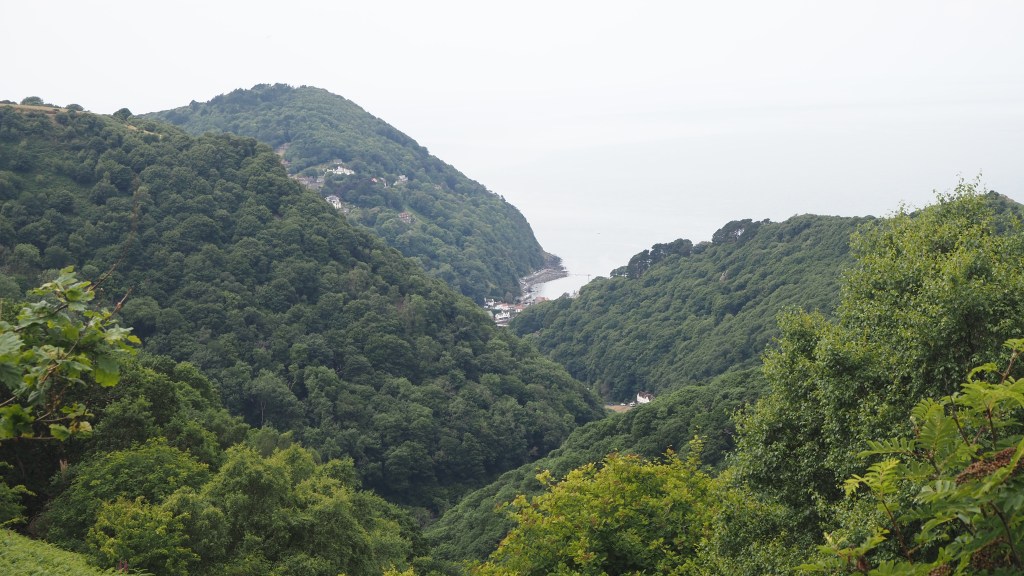
This led to Hillsford Bridge, where we took a path ascending first through the woods, and then onto the open top for glorious views across the wooded gorge, and our first glimpse of Lynmouth.

First view of Lynmouth and the surrounding wooded gorges
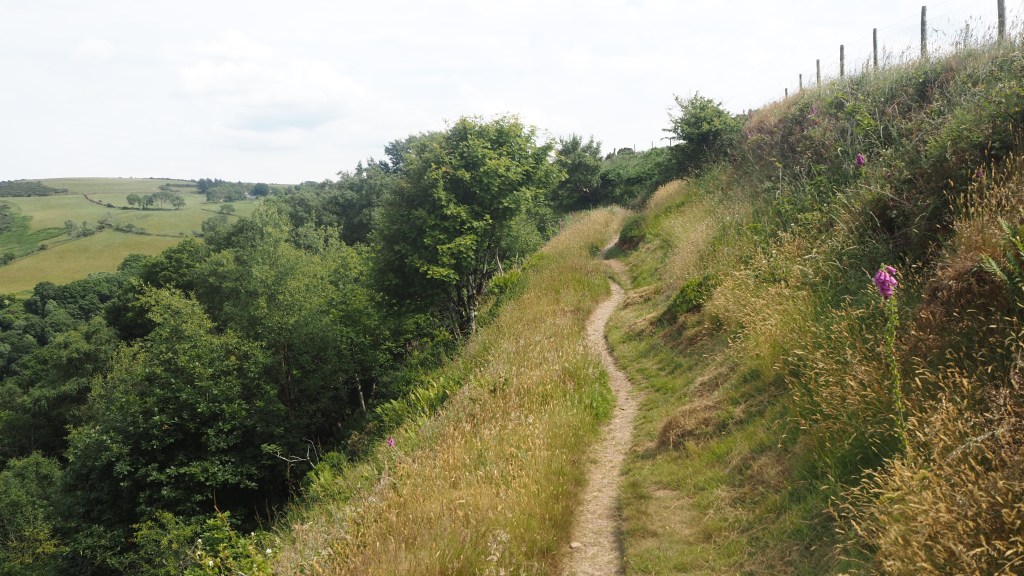
Near the top, above Lynton and Lynmouth

We started descending, which turned out to be just a preface to an even greater climb up the other side, before we finally began the long haul down to the coast and finally arrived at Lynmouth.

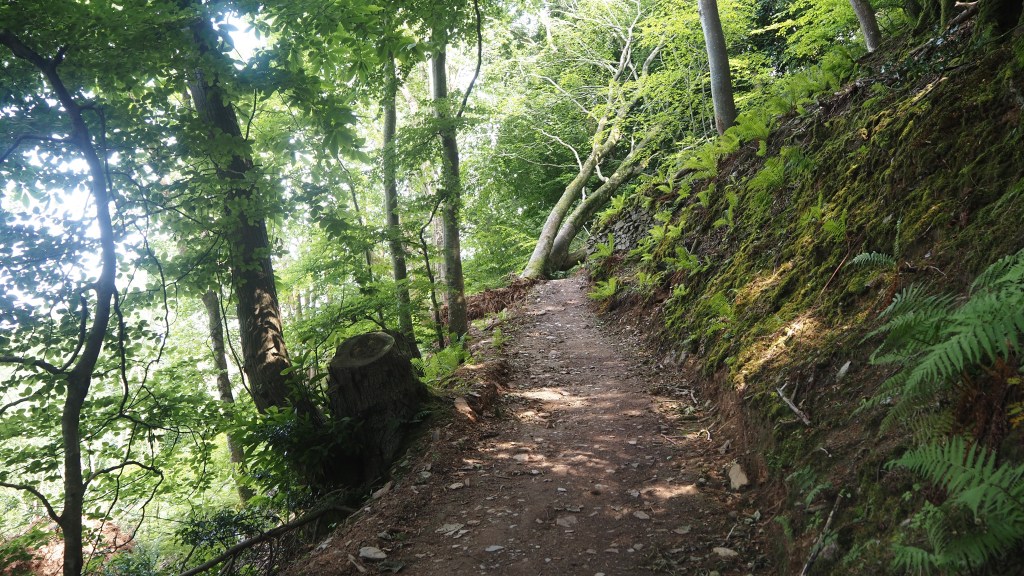
The steep descent to Lynmouth
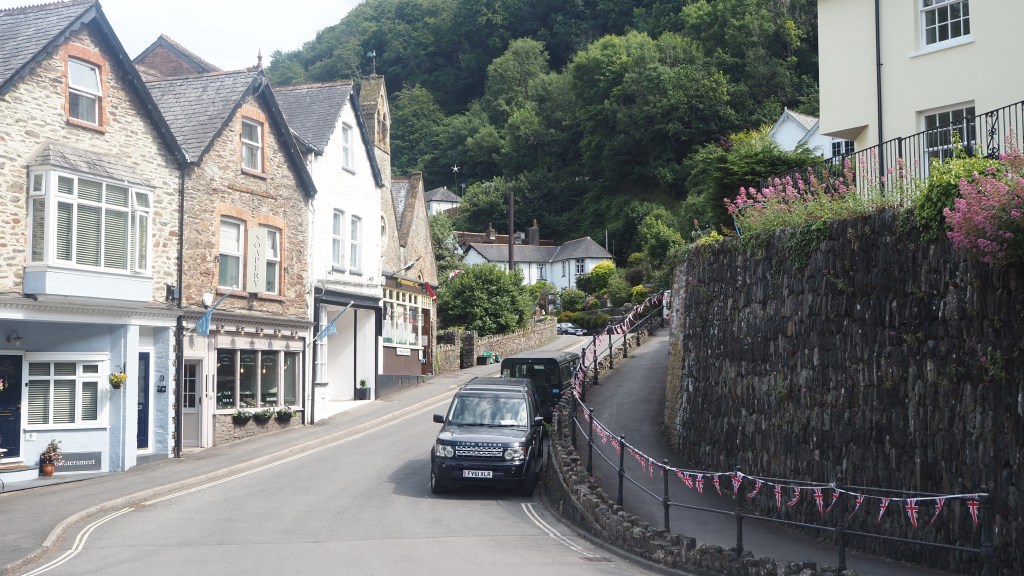
Arriving at Lynmouth

So there we are- 117 miles and ten days of walking. Another great walk, and two more national parks that were very largely new to me. Yet again we have been lucky with the British weather. While it’s sometimes been a little hotter than is ideal for walking, the dry ground really has made the moors so much easier to cross than we’d expected, particularly where there is little in the way of a clear path or we have simply been a little lost.

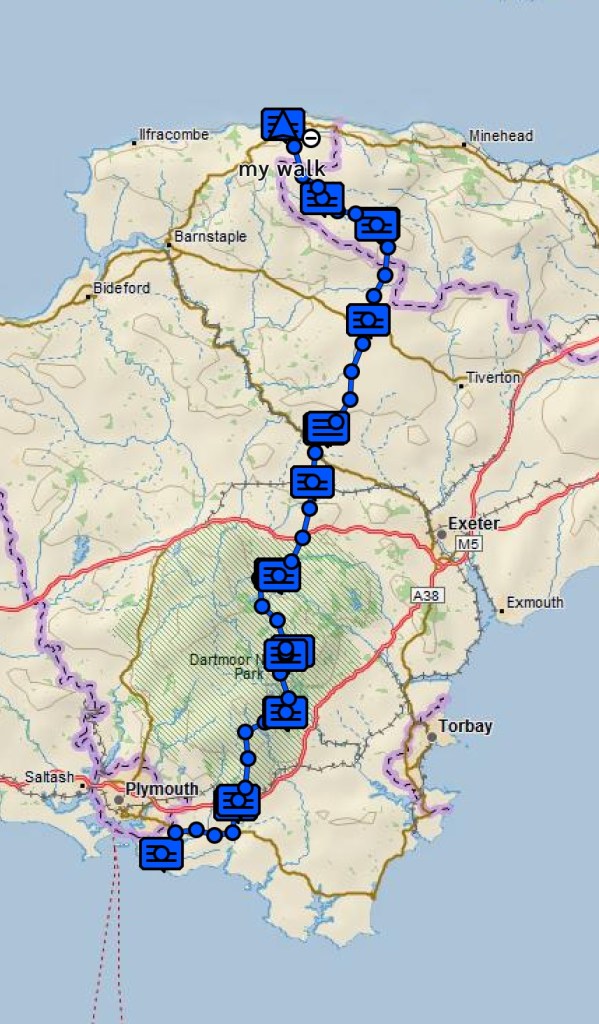
The track we walked across Devon and Somerset.
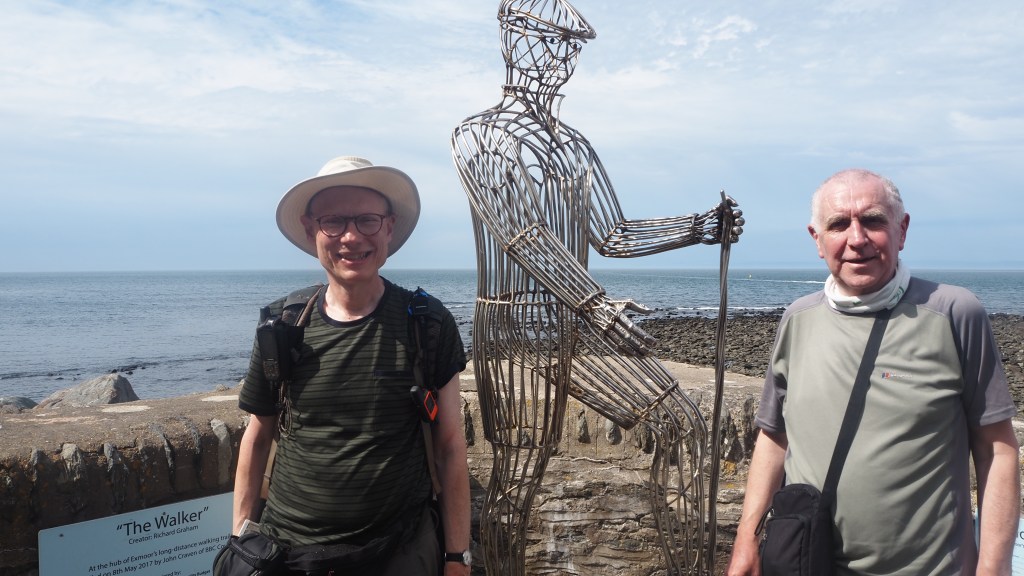
Myself and Keith at the end of the trail, by the ‘walker’ sculpture in Lynmouth

How does the Two Moors Way compare to other walks we have done in the UK? For me, the moorland sections and the stretch around the Castle Drogo estate were as good as many other such trails we have walked in the past, such as the Pennine Way, the Southern Upland Way, the Coast to Coast walk, the Rob Roy Way, the Kintyre Way or the Snowdonia Way. The bits in between, I found a bit of a mix. Some parts were really a bit bland and dull for me, being mainly field edges and high hedge lined lanes; others were really quite pretty, and enjoyable. And as I have said before, variety of terrain is one of the joys of good long distance walks.

The signage for the Two Moors way (and the Erme Plym trail preceding it) is mostly good. On Dartmoor the lack of signage is a real problem and any signage would really would make a huge difference. I think they should follow Exmoor’s excellent example. On some of the farmland sections, there are one or two missing places where an extra sign or arrow wouldn’t go amiss. But despite the impression my blog may have given, we really didn’t go wrong too often, and the combination of signs, gps and guidebook managed to get us through.

Of course for me this is just as a warm up for the ‘biggie’, the Alpe Adria Trail, which I plan to start on 6 July. 37 days of walking over around six weeks across Austria, Slovenia and Italy. Before I embark on that, can I say a big thank you to everyone who has read the blog, offered comments and compliments, and donated in support of the pangolins (if you haven’t already and wish to, please follow the link at the top of this page) .

I really do appreciate it, and I hope my little photo diary is sufficiently interesting to inspire you to try some new walks, and to follow my blog of my forthcoming trip. Please stay tuned and do let me know what you think.
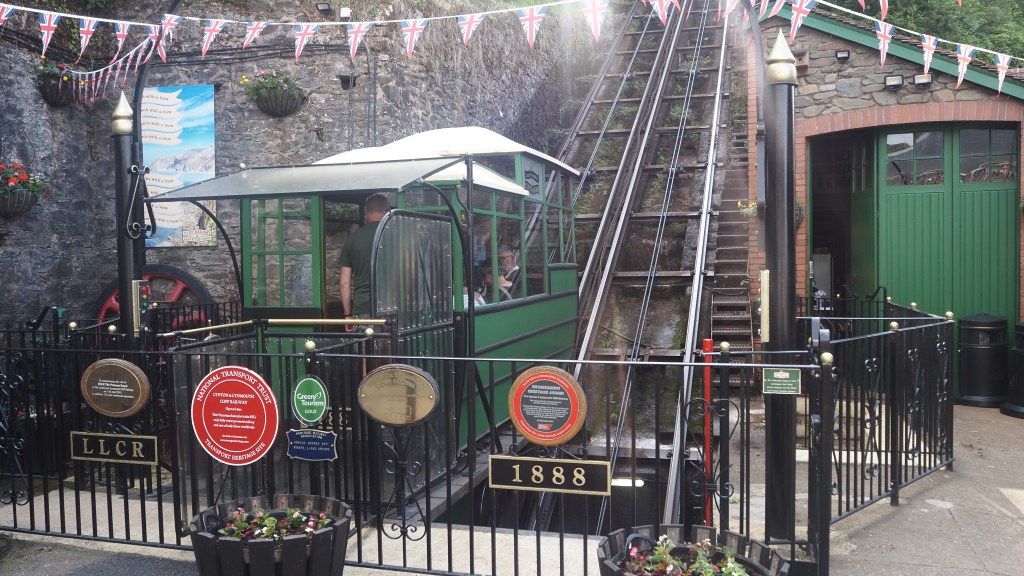
The Lynton and Lynmouth cliff railway, which we boarded after completing the Two Moors Way, to take us back to our accommodation at Lynton

Walking across Devon (and Somerset) from coast to coast: Day 9

It’s always a bit sad as you approach the end of a long distance walk. We began the day 100 miles in, with only 17 to go.. This penultimate day was a short one, only six miles long and entirely on Exmoor (and in Somerset).
We’d stayed overnight at some lovely lodgings, in a scenic spot high up overlooking the moor. It felt a long way from anywhere, in a good way. Leaving our accommodation we climbed yet further and soon we were on the top of the moor, with a clear path, good signs, and expansive views all around.

Exmoor seemed less bleak than Dartmoor, certainly on this stretch of the route. Instead of rocky tors, non existent signs, and (some) unclear and boggy trails, Exmoor was a little more tamed, with its rounded hills, little bunches of trees and gargling rivers.

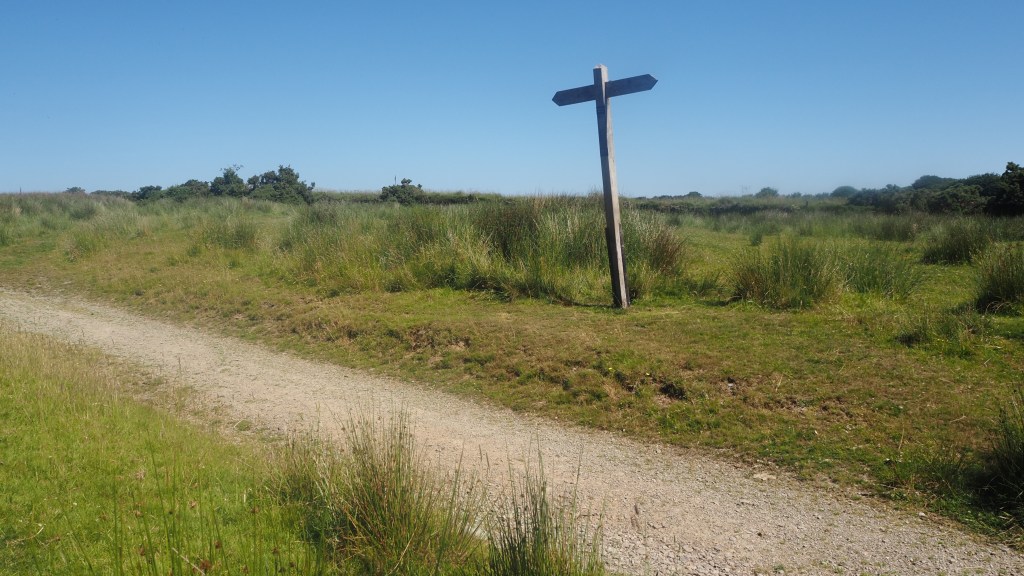
They seem to be fine with signs on Exmoor, unlike Dartmoor

We saw a few more people, and were able to follow the path clearly all the way, with fewer of the long uphill gradients of the last few days.

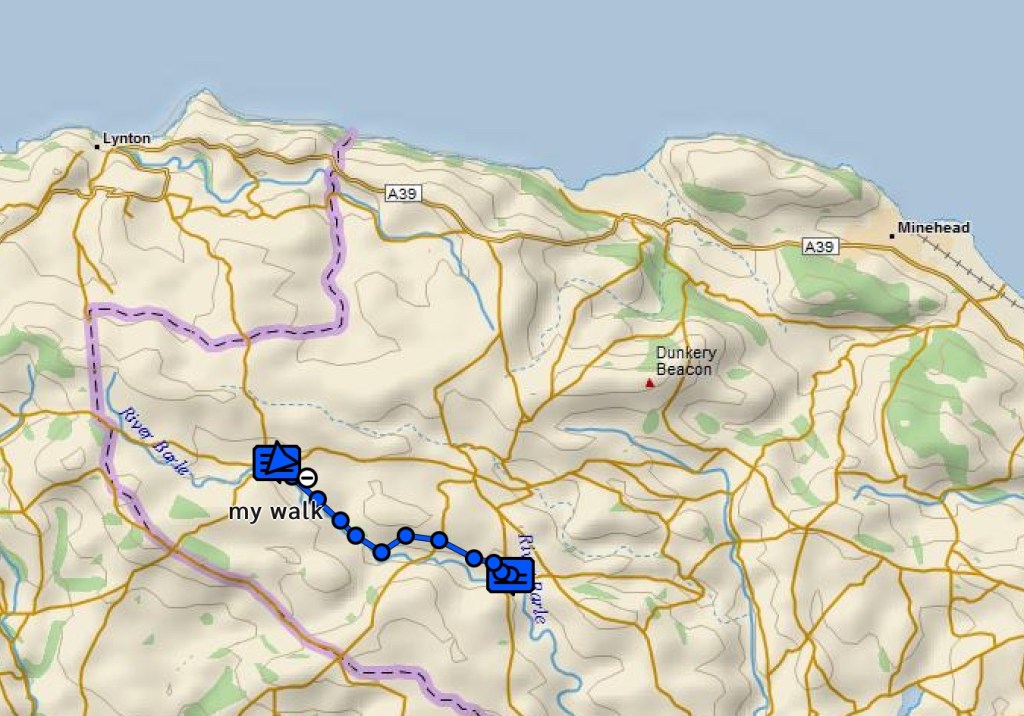
Our route was entirely in Somerset and through Exmoor today
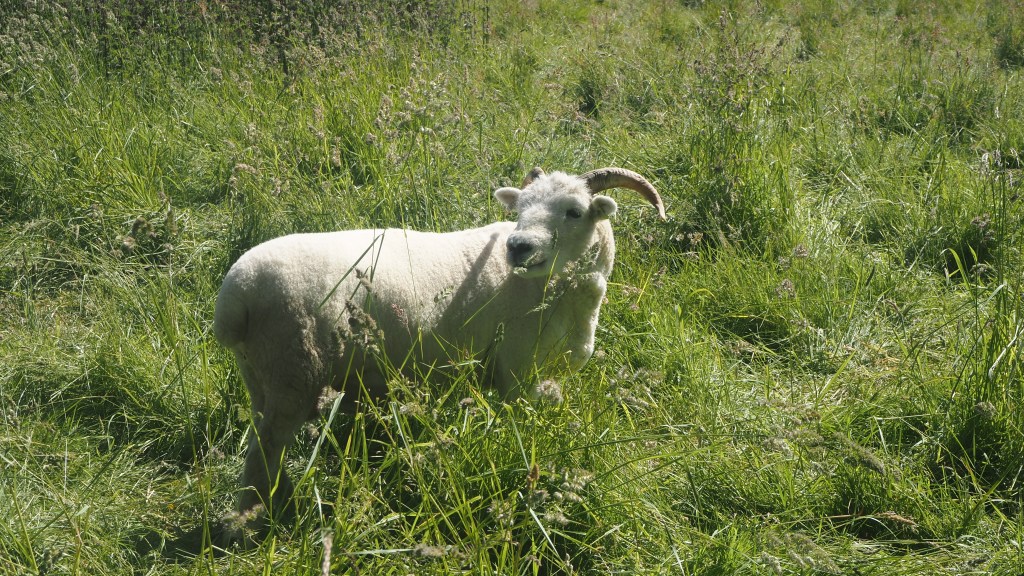
Not sure what this breed of sheep are, but they are all horned.

Dotted around were sheep, but there were no cattle or horses this time. The day was another hot one. In fact we have been incredibly lucky with the weather so far.

There were no villages, churches or thatched cottages between our start at Withypool and the end at Simonsbath- just the river Barle for company once again for much of the way.

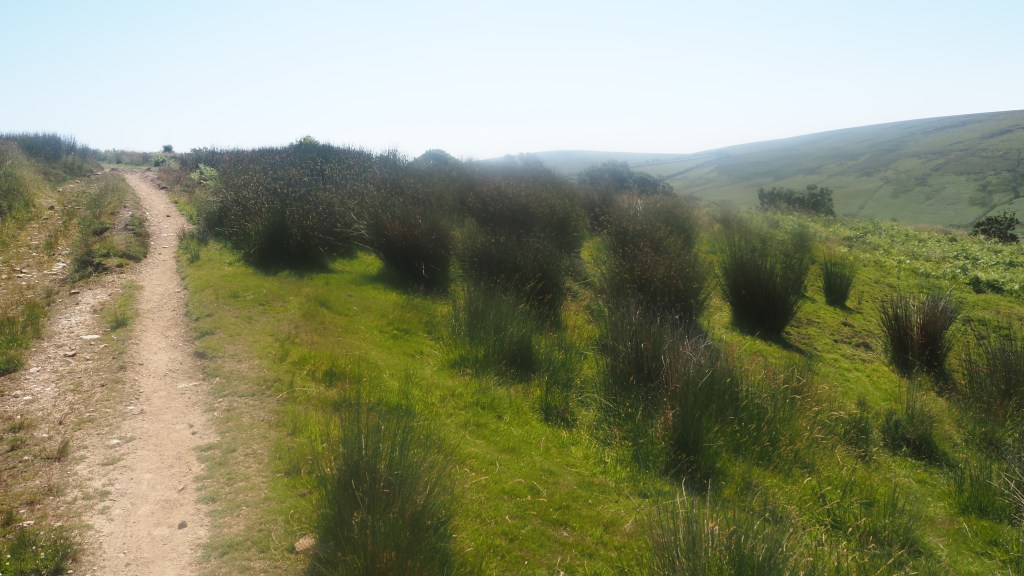
The trail today was clear, straightforward and scenic
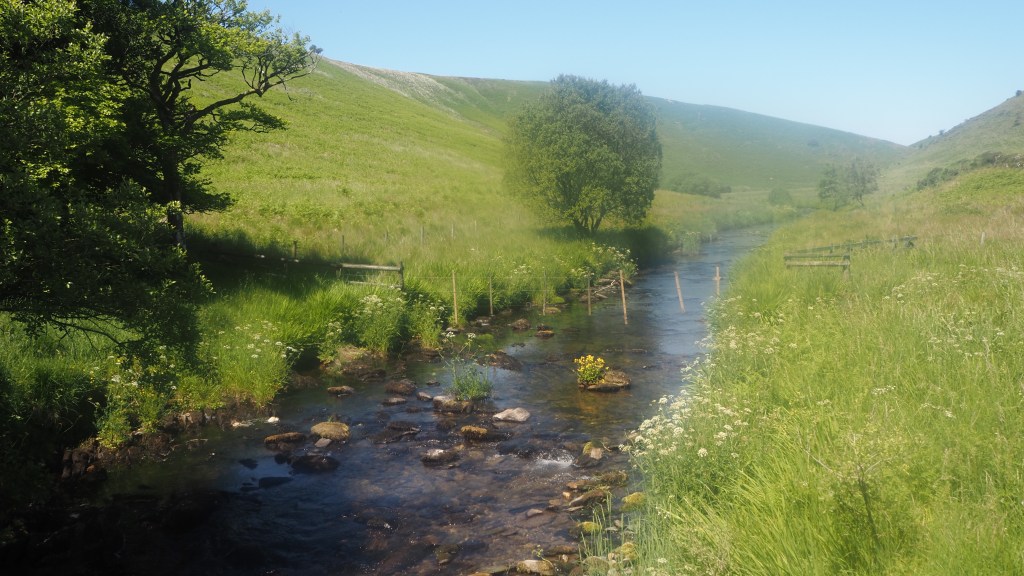
For much of the walk we followed the river
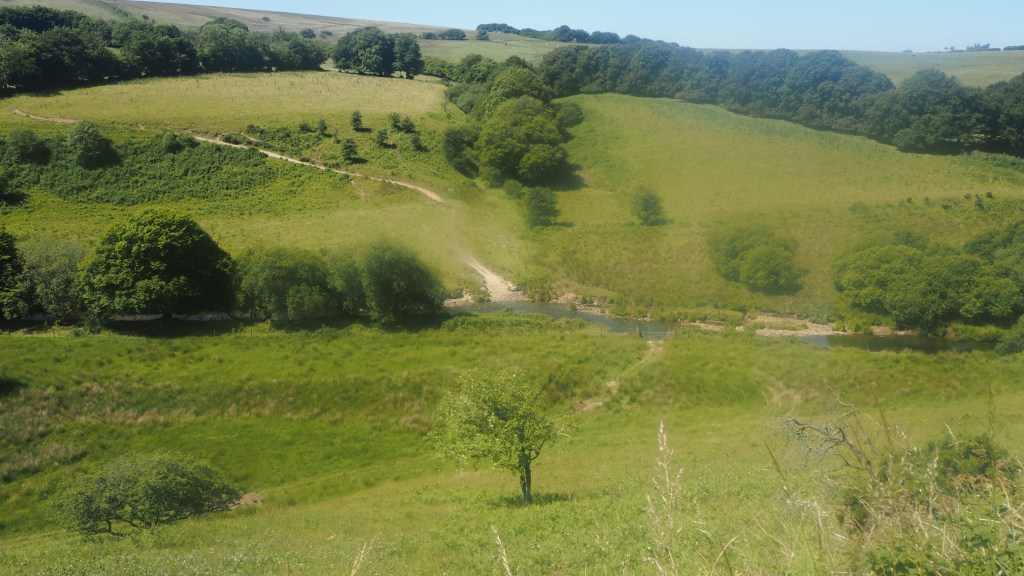
View across the rolling hills of Exmoor

We passed the remains of an iron age fort, Cow Castle, and of a copper mine, Wheal Eliza. To be honest neither was especially much of landmark. Instead we just soaked up the beauty of the countryside and the riverbank.

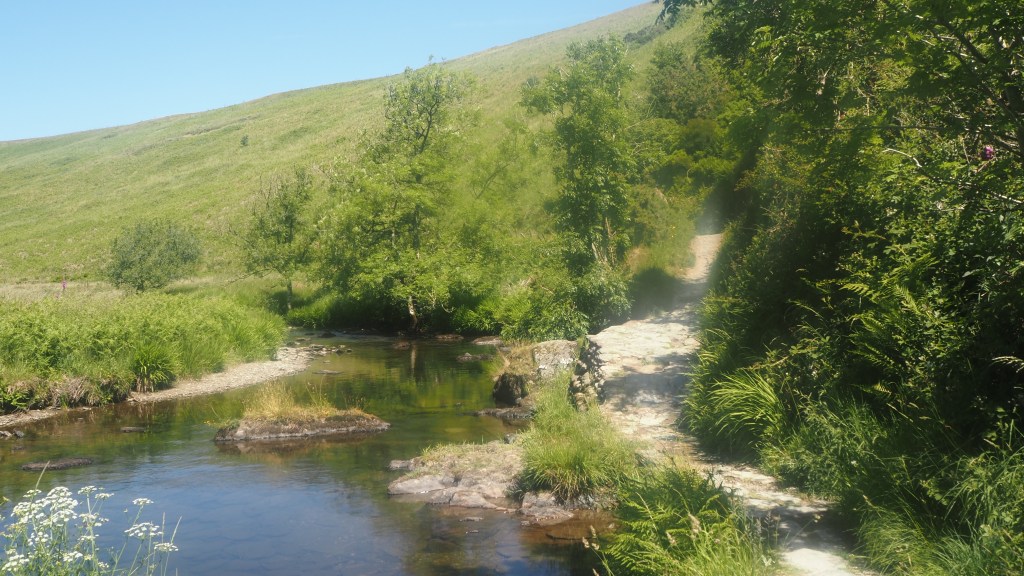
The riverside path

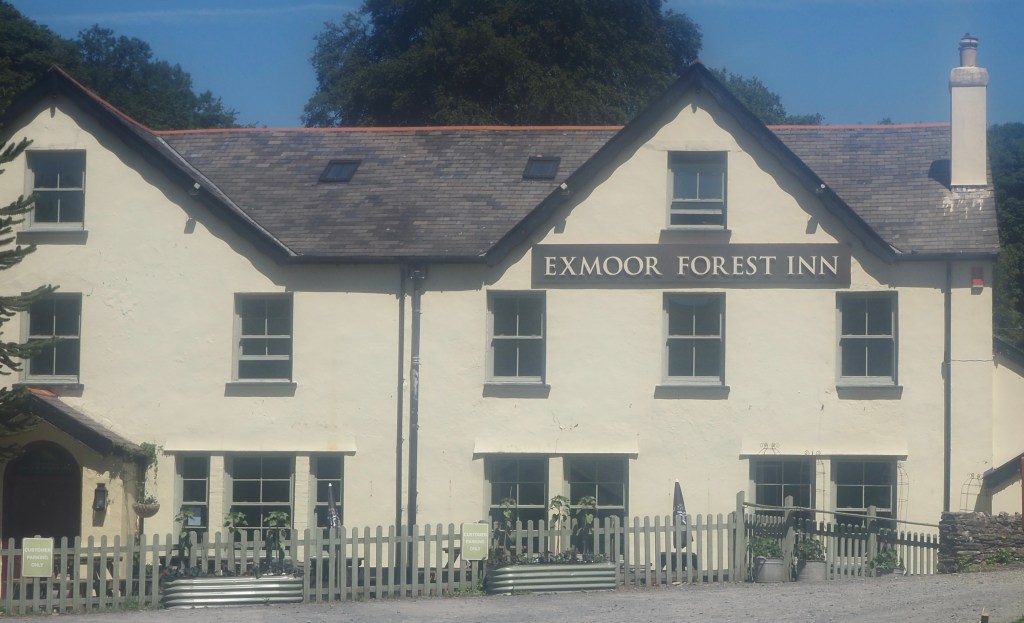
Finally we emerged at the road at our rendezvous with our taxi, the Exmoor Forest Inn, Simonsbath, where we were a little early. The pub was shut at lunchtimes between Monday and Wednesday, much to the disappointment of some young cyclists who appeared to have been aiming for it for a lunchtime pint. Instead they pedalled on, up the hill, before we boarded our taxi to our accommodation in Lynton, to which we will be walking the final stage of the route tomorrow.

Our walk ended at the Exmoor Forest inn, which was shut when we arrived.
Design a site like this with WordPress.com
Get started